
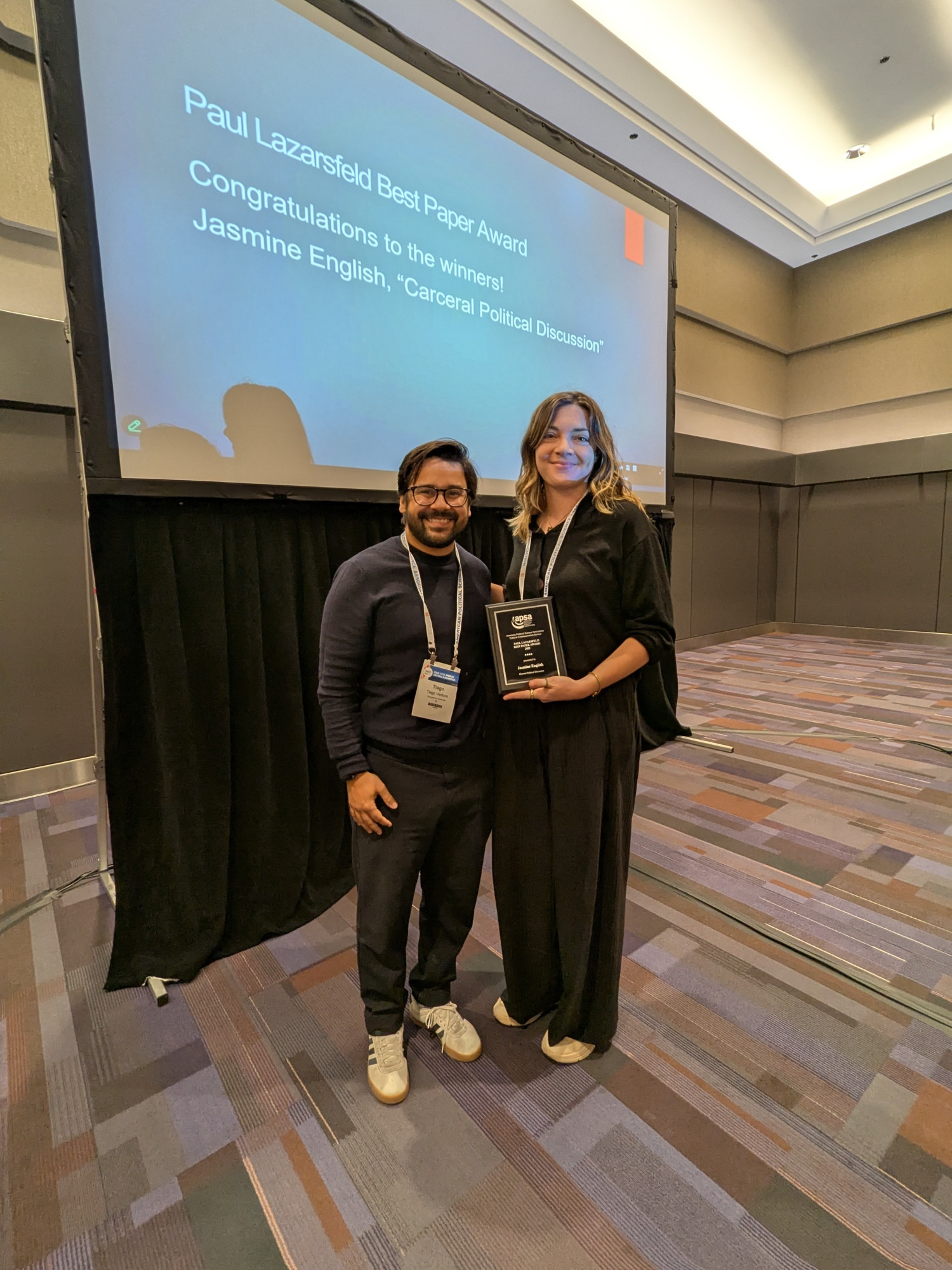
Award won:
- Paul Lazarsfeld Best Paper Award
Name(s) & affiliation:
- Jasmine English, Assistant Professor, Reed College
Project title:
- Carceral Political Discussion
Publication reference:
- English, Jasmine. 2025. Carceral Political Discussion. Working paper.
Tell us something about you/your team and how and why you decided to focus on this research
- This project began from a simple question: what counts as “political talk” and for whom? Most measures of political discussion capture only the liberal-democratic “first face” of the state (elections, parties, institutions). But for many Americans, especially Black Americans, the most immediate and consequential face of the state is the carceral one: police, courts, correctional systems. I wanted to understand whether everyday conversations about policing and criminal justice function politically even though they fall outside conventional survey items. The project grew out of a broader interest in how racial power structures shape the lived experience of citizenship and what we count as participation.
Summarize the main takeaway of your project.
- Black Americans discuss policing and the criminal justice system more than white Americans — reversing the conventional discussion gap — and these conversations have distinct consequences for efficacy, identity, and engagement.
What made this project a “polcomm project”?
- The project tries to reconceptualize what counts as political discussion and examine how citizens communicate about different faces of the state. By combining survey methods with “analytic listening” to real-world conversations from the Fora platform, the project demonstrates that what we talk about and the political implications of that talk vary significantly by the domain of politics under discussion. In so doing, the project expands the boundaries of political communication research beyond traditional electoral-representative topics.
What, if anything, would you do differently, if you were to start this project again? (What was the most challenging part of this project? …& how did you overcome those challenges?)
- The most challenging aspect was developing a valid measure of carceral discussion content. Rather than assuming which topics matter, I used grounded theory and “analytic listening” to inductively identify discussion topics from 44 real-world conversations on the Fora platform. This involved multiple rounds of qualitative coding to develop a battery of positive and negative carceral discussion topics. If I were to start again, I might expand the initial listening phase to include more diverse conversation settings and explore additional carceral domains like immigration enforcement earlier in the process.
What other research do you currently see being done in this field and what would you like to see more of in the future?
- There is growing interest in bringing the carceral state into the study of political behavior and communication, but much of the field still defaults to liberal-democratic institutions as the anchor of “politics.” I would love to see more work that treats the state as multifaced and coercive, and that foregrounds how marginalized groups learn about politics through policing, punishment, and surveillance. Methodologically, I also hope to see more efforts to use listening and ethnography not only to illustrate but to build survey instruments.
What’s next? (Follow-up projects? Completely new direction?)
- My next step is to extend the analysis to immigration enforcement and child protective services, two institutions that similarly blur the line between “public policy” and surveillance. More broadly, I see this as part of an effort to reconceptualize participation from the standpoint of those who experience the state primarily as regulation and threat rather than as representation.
Awardee Interview: Paul Lazarsfeld Best Paper Award (2025)