Awardee Interview: Walter Lippmann Best Published Paper Award (2023)

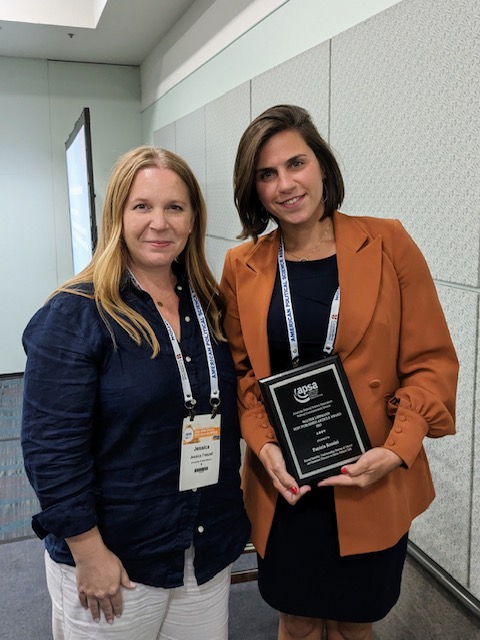
Jessica Feezell presenting the Walter Lippmann Best Published Article Award to Patricia Rossini

Award won:

  • Walter Lippmann Best Published Paper Award


Name(s) & affiliation:

  • Patrícia Rossini, Senior Lecturer in Communication, Media & Democracy in the School of Social and Political Sciences at the University of Glasgow


Project title:

  • Beyond Incivility: Understanding Patterns of Uncivil and Intolerant Discourse in Online Political Talk.


Publication reference, link (APA 7th):

  •  
  • Rossini, P. (2022). Beyond Incivility: Understanding Patterns of Uncivil and Intolerant Discourse in Online Political Talk. Communication Research, 49(3), 399–425. https://doi.org/10/gkfj98


Tell us something about you/your team and how and why you decided to focus on this research

  • This paper summarizes the main findings of my PhD research. I originally started my PhD journey thinking about online political talk in more normative terms, aligned with scholarship in deliberation and the public sphere. Reading the literature on online political talk, though, I was surprised by the intense focus on incivility and lack of ‘respect’ as an inherently undesirable characteristic of political conversations, and realized that scholars were neglecting types of opinion expression that are more problematic in Hence, I decided to develop a content analysis scheme that disentangled tone and substance to understand the different conditions under which antinormative discourse manifests online.


In 280 characters or less, summarize the main takeaway of your project.

  • My work advances a conceptual model that disentangles uncivil and intolerant online political talk, enabling scholars to disentangle discourse that is harmful from expressions that are not, and demonstrates that these two types of discourse occur under different conditions.


What made this project a “polcomm project”?

  • This project considers one of the core concerns of polcomm—informal political conversations—and advances its understanding by advancing a nuanced account of how people express their political opinions online, and how antinormative political talk may be facilitated by platform affordances.
  •  

What, if anything, would you do differently, if you were to start this project again? (What was the most challenging part of this project? …& how did you overcome those challenges?)

  • As with any doctoral research, there are things I would have done differently if I knew at the time. I would have tried to develop supervised machine learning models to detect uncivil and intolerant discourse at scale if I had the skills to do so back then—something that I only accomplished more recently, and in English language. I would also have expanded the platform comparisons beyond online news websites and Facebook, which I did not have the resources to do. Looking back, I am proud of what this project accomplished considering the conditions under which I developed it as a PhD student in Brazil.


What other research do you currently see being done in this field and what would you like to see more of in the future?

  • There’s been a lot more work on perceptions of antinormative discourse—including, but also beyond incivility—that goes in the same direction of what I argued in this paper: people are not universally affected by incivility, and incivility alone is not enough to undermine the value of political talk. I would like to see this work on perceptions and differential effects continue to develop, as well as a consideration of how antinormative discourse affects bystanders. There’s been much less focus on more harmful online expressions—which I define as intolerant—, and I think that’s the direction for future work.


What’s next? (Follow-up projects? Completely new direction?)

  • I’ve been doing many related things since this project. I followed up on this conceptual model as part of a collaborative grant funded by Twitter, which enabled me to develop algorithms to detect five subtypes of incivility and two subtypes of intolerance—which is a lot more nuanced than more common binary approaches to this task. I also have another on-going project focused on perceptions of intolerance. More broadly, my research has considered other digital threats to democracy, like misinformation and disinformation.


  • Bianchi, F., HIlls, S., Rossini, P., Hovy, D., Tromble, R., & Tintarev, N. (2022). “It’s Not Just Hate”: A Multi-Dimensional Perspective on Detecting Harmful Speech Online. Proceedings of the 2022 Conference on Empirical Methods in Natural Language Processing, 8093–8099. https://aclanthology.org/2022.emnlp-main.553


Awardee Interview: Kaid-Sanders Best Article of the Year (2023)

le-ri: Greg Chih-Hsin Sheen; Hans H. Tung; Wen-Chin Wu

Award won:

  • Kaid-Sanders Best Political Communication Article of the Year Award (2023)
  •  

Name(s) & affiliation:

  • Greg Chih-Hsin Sheen (Assistant Research Fellow, Institute of Political Science, Academic Sinica)
  • Hans H. Tung (Professor, Department of Political Science, National Taiwan University)
  • Wen-Chin Wu (Associate Research Fellow, Institute of Political Science, Academic Sinica)
  •  

Project title:

  • Power Sharing and Media Freedom in Dictatorships
  •  

Publication reference:

Tell us something about you/your team and how and why you decided to focus on this research

  • Since 2017, we have worked together as a team to investigate various issues surrounding the politics of media freedom in dictatorships on both theoretical and empirical fronts. Up to now, we have collectively published more than five peer-review articles in academic journals. From the very beginning of our collaboration, we all felt there was a lack of enough theoretical discussions as well as solid empirical works on dictators’ commitment problem and how it affected media freedom in authoritarian regimes. Especially, there was a lacuna on how this problem played out in the intra-elite power sharing relationship under dictatorships. We therefore decided to embark on various projects that examined this question systematically.


In 280 characters or less, summarize the main takeaway of your project.

  • The paper develops a new power-sharing theory of media freedom under dictatorships and demonstrates quantitatively that the level of (partial) media freedom in them goes up when the level of their intra-elite power sharing is higher.
  •  

What made this project a “polcomm project”?

  • The media politics in dictatorships has received lots of scholarly attention among political communication scholars recently. The topics range from how citizens living under authoritarian regimes have their voices heard or banned on the internet to how media outlets and their reports affect political stability in these regimes. Our endeavor contributes to this larger “polcomm project” by endogenizing dictators’ decisions over media freedom to their power-sharing relationship with their political allies.    
  •  

What was the most challenging part of this project? …& how did you overcome those challenges?

  • The most challenging part of this project was to put together a dataset with all the variables needed to test our theoretical propositions. The vast majority of authoritarian countries are very opaque and testing our theoretical ideas nonetheless calls for measures of intra-elite interactions in them such as power sharing or elite cohesion. Thanks to several recent data collection projects on dictatorships and media freedom, we were able to overcome the challenge and find convincing evidence for our theory through thorogh quantitative analyses.
  •  

What other research do you currently see being done in this field and what would you like to see more of in the future?

  • Currently, most research in the field of authoritarian politics of media has been centered around the interactions between different mechanics of information/media control and the corresponding state-society relations under dictatorships. Especially, the (partial) media freedom in them is predominantly viewed as its strategy for acquiring information about social reactions to their rule. What we would like to see more of in the future are several new avenues of research our research helps open up.
  • First, while our analyses have taken the first step to disclose the effect of intra-elite power sharing on media freedom under dictatorships, the measures of media freedom in our paper are however all aggregate ones. Since different types of media outlets—e.g., print, broadcast, or internet—might actually have different effects in sustaining intra-elite communications and power-sharing, a natural next step will be more theoretical and empirical endeavors to identify such variegated effects of different media types. Relatedly, as the information and communication technology advances so quickly nowadays, we would also like to encourage the community to investigate how dictatorships with different state capacity adapt to it, not just for meeting new social demands but also for handling intra-elite power dynamics.
  • Second, the findings from our research also add another layer to the recent discussions about digital authoritarianism that mainly focus on how dictators’ newly gained digital power over media freedom enables them to consolidate their social control. However, as far as the survival of an authoritarian regime is concerned, media control is never exclusively about social control, but also about how the regime manages the power sharing relationship among its political elites. More media control might actually undermine the very foundation on which its intra-elite cooperation is based. How do dictators strike a balance between these two objectives? We will need more theoretical investigations and data collections to answer this question.
  •  

What’s next? (Follow-up projects? Completely new direction?)

  • Based on our previous publications on the authoritarian politics of media, we continue to broaden our scope of investigation in addition to the directions suggested above. First, based on our new game-theoretic publication where we investigate formally conditions under which the media engage in self-censorship even though the dictator tries to commit to media freedom (Journal of Theoretical Politics, forthcoming), we are designing a lab experiment to empirically test some of its predictions. Second, another collaborative project of ours focuses on how dictators choose between free media and other political institutions to maintain regime stability. This project is also based on the theoretical insights derived from our power sharing project. Finally, our third project tries to find individual-level determinants for ordinary citizens’ support for media censorship in democracies and support for media freedom in autocracies.
  •  
  •  


Awardee Interview: Best Dissertation Award (2023)

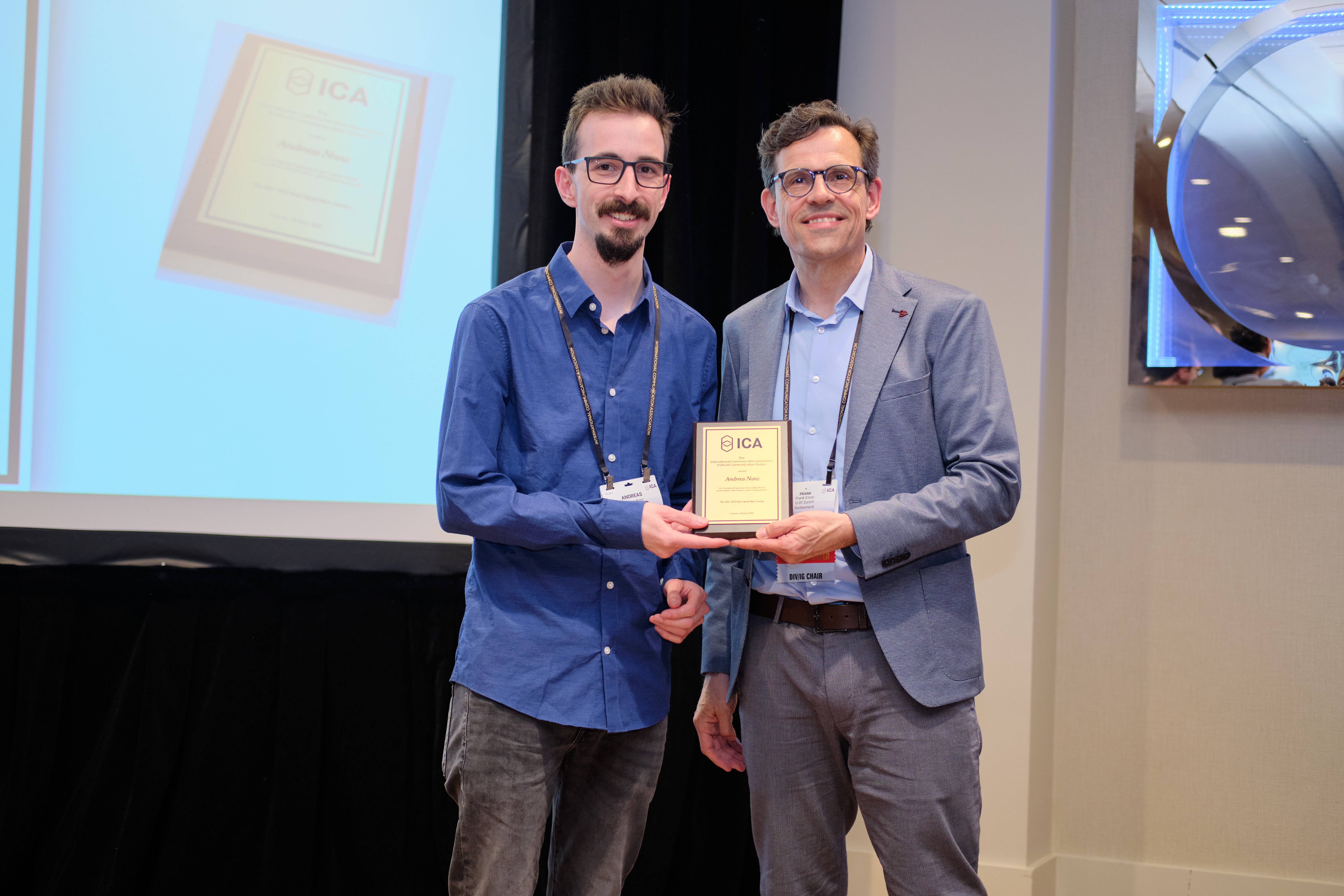
Andreas Nanz accepting the PolComm Best Dissertation Award from Frank Esser at ICA23

Award won:

  • Political Communication Division Best Dissertation Award


Name(s) & affiliation:

  • Andreas Nanz (University of Vienna, Austria)


Project title:

  • Incidental exposure in the online world: Antecedents, mechanisms, and consequences
  •  

Publication reference, link (APA 7th):


Tell us something about you/your team and how and why you decided to focus on this research

  • A few months after starting my PhD position in a funded research project, we stumbled upon a call for papers for Journalism about incidental news exposure. Since I had read a couple of incidental exposure papers a bit prior for another paper, we knew the limitations of the current research in this area and had a couple of ideas for future research. Thus, for the CfP, we decided to write a theoretical paper as a first stepping stone. In the end, it was the political incidental news exposure model (PINE). The dissertation was the empirical test of this model.


In 280 characters or less, summarize the main takeaway of your project.

  • The phenomenon of incidental exposure (IE) is much more nuanced than previously expected. We should distinguish different levels of IE (brief scanning vs. thorough scanning) and not forget that there is a lot of non-political information which might also distract from politics.


What made this project a “polcomm project”?

  • The literature about incidental exposure very much sits at the intersection between communication and political science. Often studies ask the question how media exposes individuals to political content they did not intend to see and what kind of consequences this incidental exposure has for politically relevant variables such as political knowledge or participation. In the final study of the dissertation, we tried to shift this frame a bit by focusing on the impact of non-political incidental exposure on political information processing.


What, if anything, would you do differently, if you were to start this project again? (What was the most challenging part of this project? …& how did you overcome those challenges?)

  • Since I consider writing a dissertation also as somewhat of a “learning journey”, I would do many things differently. For example, I would not try to field a study in schools in the first weeks after the school year starts. Of course, I would also get rid of the typo I recently found in one of my published studies. Regarding challenges, the global pandemic was certainly a bump in the road.


What other research do you currently see being done in this field and what would you like to see more of in the future?

  • I think that this sub-field of political communication research has done a big step with and also since the special issue in Journalism in 2020. I’m also thrilled to see that some ideas and approaches from this dissertation found their way into studies by other scholars in the field. In the larger field of political communication, I very much enjoy reading the small but growing bulk of experimental studies that try to recreate or simulate the complexity and fuzziness of contemporary real-life information environments.


What’s next? (Follow-up projects? Completely new direction?)

  • The question “what’s next” I have not fully answered yet. But I’m currently involved in multiple projects with colleagues from my team, some also related to political communication. And, there are still two follow-up studies related to the dissertation’s topic in the making. So, stay tuned!


Letter from the Editor: Re-launching the PCR

Re-launching the Political Communication Report: A Space for Collective Self-reflection


Curd Knüpfer, Freie Universität Berlin

http://dx.doi.org/10.17169/refubium-39040; PDF


The last issue of the Political Communication Report (PCR) was published in 2016. Since then, populist parties and elites have reshaped digital campaigning. Progressive and reactionary movements have formed around hashtags and meme-driven protest formats. The global pandemic transformed the way we collaborate and “meet” one another. Meanwhile, the prisms through which we come to view politics – news outlets and social media platforms – are undergoing rapid transformations, while emergent forms of AI are poised to have a profound transformative impact on our digitally networked societies. In short: political constellations have changed immensely, as have communication dynamics.

Arguably, political communication scholarship has always been focused on moving targets. But if you are like me, you can’t help but notice how these targets seem to be picking up speed, while simultaneously multiplying. So in light of all this noise, all these new possibilities for doom-scrolling, and the constant assault on our collective capacities for attention, do we really need another info outlet? The obvious answer is: no.

The more sophisticated one is: perhaps – but it probably needs to look like what we have in mind with the new Political Communication Report (which is really also the old Political Communication Report).

Allow me to briefly lay out what this entails: Beyond the immediate institutional work of the two divisions, we might think of political communication as a network, a field, or a community. As scholars of such things, we know that whatever label we use here, these forms of connectivity depend on communicative ties – on building and maintaining connections that provide pluralistic and inclusive communicative spaces. The more connected we all are, the more we all benefit. But for this to happen, we also need to be able to collectively self-reflect.

It is in this spirit that the PCR will foster cooperation between established and emerging voices interested in shaping our collective conversations. The success of this endeavor will depend on all of you, as readers, as contributors, as a network, a field, a community. Collectively, we want to provide a communicative space that is more dynamic than our journal publications, but less ephemeral than social media posts. The overarching themes of the upcoming issues are therefore guided by a commitment to pluralism and self-reflexivity.

Let’s take a look at what we have so far: Issue 1 (of 2) for 2023 introduces some new and some familiar names via the format of our “Awardee Interview Questionnaires.” Here, the authors that were awarded various division prizes in 2022 introduce themselves and tell us about their (ongoing) research process.

Meanwhile, the thematic essays focus on the topic of “New Methodological Diversity in PolComm.” In my role as editor, I honestly didn’t do much other than provide this prompt to members of our community, to solicit their input. Despite hectic schedules, the enthusiasm for this project was astounding. Practically everyone I tapped immediately agreed to contribute to the PCR. I am extremely grateful to be able to announce that the relaunch issue consists of a collection of incredibly thoughtful, timely, and highly important contributions:


Reading these pieces, it is striking how much they complement one another, pointing to various parts of the metaphorical elephant that comprises our field. An unprompted theme that emerges is the acknowledgment that political communication (research) does not take place within a vacuum: Just as the context of political dynamics matters, so do the people who contribute to studying them. On that note, and beyond our wonderful contributors, I want to thank the two division chairs, Frank Esser and Sharon Jarvis as well as Patricia Moy for their input and guidance on this re-launch project. And finally, I want to applaud the fantastic work of my predecessor Eike Rinke, the PCR’s last editor – all I’ve been doing this past year is to try to fill the shoes he left me. Along with Joshua Scacco, the previous social media manager and webmaster, he has been more than generous with his time and council.


Curd Knüpfer, May 2023


Growing, Evolving, Engaging: The Latest from ICA’s Political Communication Division

Growing, Evolving, Engaging: The Latest from ICA’s Political Communication Division


Frank Esser, Chair of ICA’s Political Communication Division

I am happy to report that the Political Communication Division is on solid ground with professional practices and stable finances, but we face challenges in diversifying and expanding our international presence. Our focus is on nurturing talent, expanding global reach, improving services, fostering member interaction and strong representation within the ICA community. To address new challenges and ensure inclusive growth, at the last Business Meeting in Toronto I introduced a Strategic Planning Task Force to explore new goals, adapt to the evolution of the field, manage the complex peer review process, enhance engagement for online conference participants, consider new leadership roles, and possibly update our mission and bylaws.


How Do We Operate Behind the Scenes?

The Political Communication Division’s leadership team consist of Division Chair (me), Vice Chair and Program Planner (Kate Kenski), International Liaison Officer (Taberez A. Neyazi), Student and Early-Career Officer (Ernesto de Leon), Secretary and Treasurer (Ashley Muddiman) and Social Media Officer (Curd Knüpfer). We hold monthly 90-minute Zoom meetings to plan and coordinate a growing number of initiatives. At conferences, you will meet us at the various networking and mentoring events we host, at our legendary off-site receptions, and at the all-important Business Meeting.

The Chair’s responsibilities are extensive, including organizing monthly leadership team meetings, coordinating divisional tasks, overseeing a number of committees, managing finances with the Secretary, and liaising with the journal Political Communication, the PolComm section of APSA, and ICA headquarters. In addition, the Chair produces a monthly newsletter. While the activities of other officers are too numerous to list here, their activities and dedication are at least as important, if not more so, and I would like to take this opportunity to thank them for their time and energy.

I cannot overstate the importance of our monthly officer meetings to the success of our division. These meetings guide our work, enable strategic initiatives, and allow for informed decision making. We are all actively involved in several other broader ICA committees. We maintain close friendships with some of the ICA divisions (especially those where we also have a larger membership overlap), and a goal for the future is to increase interdivisional cooperation in general for more robust exchanges.

Filling officer positions has never been a problem in our division, thanks to a long-standing Nominating Committee (currently chaired by Patricia Moy) that prepares election slates with a variety of expectations in mind. Although people tend not to self-nominate out of respect for the structured processes we have in place, our members are always willing to serve when approached.

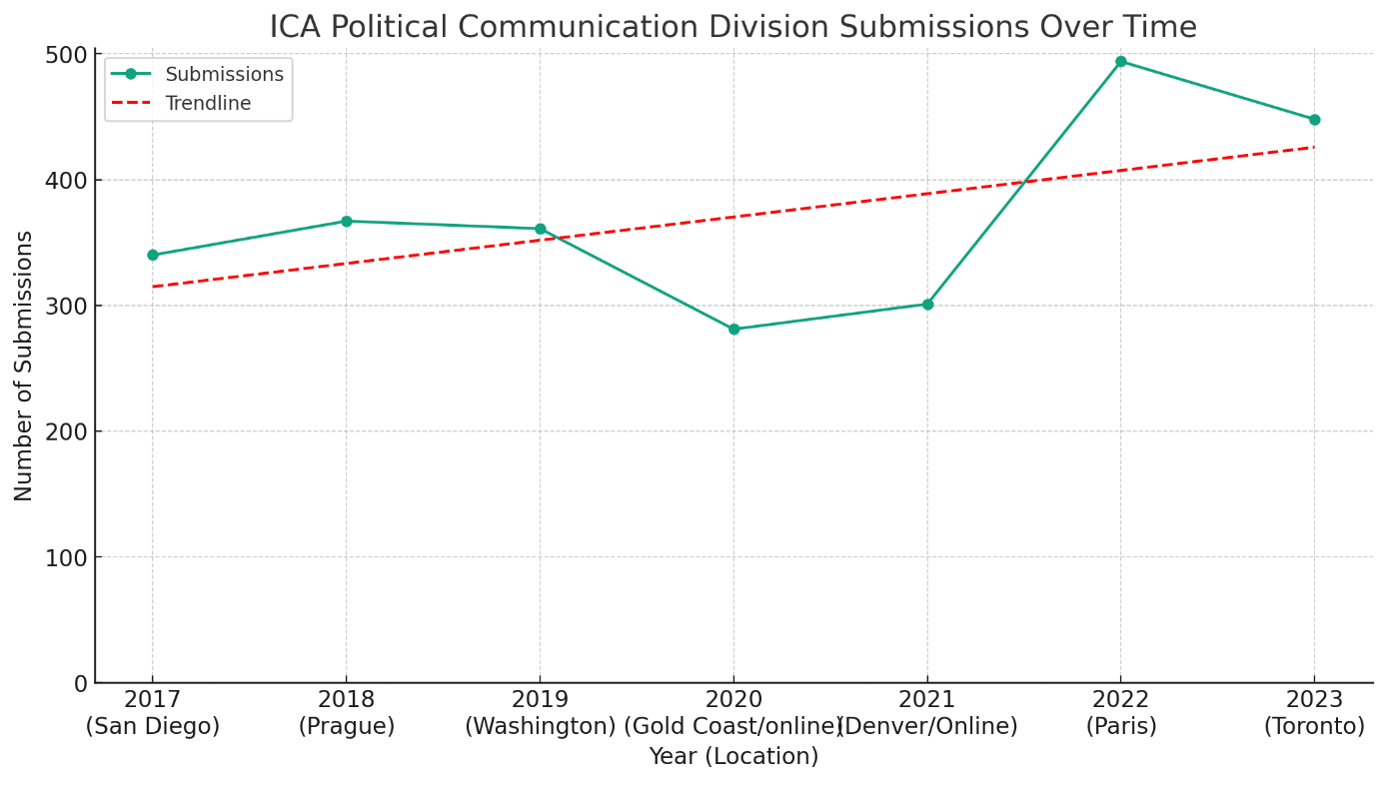
One of our biggest challenges is the role of the Program Planner (= Vice Chair). The current scale of operations, with nearly 500 submissions (for Paris and Toronto) and multiple submission formats, has pushed the limits of what one person can manage. Tight deadlines, restricted access to ScholarOne post-deadline, and balancing scientific diversity with high peer review standards add to the complexity. At least for the “Big 5” divisions (CAT, Health, Journalism, PolComm, MassComm) we believe a structured dialogue with ICA is needed to redefine the role of the planner, moving beyond ad hoc internal solutions to a more systematic approach.


Membership Growth and Diversity Efforts

The Political Communication Division has rebounded impressively post-pandemic, becoming the second-largest ICA Division with 966 members, up from 724 in 2022, and one of the most active in terms of submissions. This indicates strong loyalty and a sense of community among participants. Our field of Political Communication is highly relevant both academically and socially, and the Division is known for methodological rigor and high-quality scholarship. The balance of long-term members and new conferences attendees reflects the vitality of our Division.

To ensure an equitable and engaging conference experience, our Division has implemented several strategies to seamlessly integrate international and early career scholars into the program: (1) We avoid creating segregated panels that might inadvertently marginalize international scholars. Our panels are organized according to the thematic relevance. (2) We’ve increased our support mechanisms in terms of travel grants, striving for an inclusive experience for newcomers. (3) We plan new initiatives based on our discussions with colleagues and on the results of surveys we conduct with our members every year.

For instance, in the past three years, we have been running very successful webinars on “Political Communication for Newcomers,” in which we introduce young and less experienced researchers from around the world to the idea of submitting papers to ICA. We explain the requirements and the peer review process well in advance of the November 1 deadline. In these webinars, the Internationalization Liaison, the Student & Early Career Representative and the Secretary/Travel Grant Manager provide valuable advice.

Our membership demographics show a gradual shift from a predominantly Euro-American base to increasing representation from Asia, the Middle East, Africa, South America, and Oceania. This positive trend reflects the Division’s commitment to internationalization and diversity. The percentage of our division members from Europe and North America has declined slightly to 82%, while this year it is 9% for Asia, 4% for the Middle East and Africa, 2% for Oceania and 2% for South America. Our International Liaison, Taberez Neyazi, interprets this as part of a positive evolution compared to the times when 95% of the members came from “Euroamerica”. In the PolComm program of the Toronto conference, the first authors reported the following home institutions: 50.5% from Europe, 34% from North America, 9% from Asia, 2% from Israel and Africa, 3% from Oceania, and 1.5% from South America. However, despite a notable increase in global participation, submissions from Africa and Oceania remain low.

We also hope to diversify further. At the Toronto Business Meeting, we introduced the Facilitating the Advancement of Integration and Representation (FAIR) Fund, an initiative to promote inclusivity and diversity within the PolComm Division. This visionary program recognizes the importance of providing spaces specifically designed to empower underrepresented groups within our community. As a testament to our commitment, we are pleased to announce a pilot allocation of $3,000 USD for the upcoming 2024 conference in Australia. This funding will allow for IDEA-driven initiatives such as networking events, short workshops, and pre- or post-conference activities. More information and application details are available here.

To bolster internationalization, we are currently planning a workshop in Delhi in August 2024 to support Southeast and South Asian scholars with ICA submissions.

We’re also expanding virtual mentoring for Global South scholars and networking with key academic institutions in Asia and Latin America to broaden our division’s influence.


Mentorship Initiatives

Every two years, our division organizes a pre-conference for graduate student in political communication. This year in Toronto, it was held on the Thursday before the main conference, and was again a great success. It gave 70 doctoral students from around the world the opportunity to receive feedback on their political communication dissertation projects. The program with all participants is available here. The preconference has three main goals. 1) Get feedback from senior colleagues and peers on your PhD research.  2) Provide insights on important aspects of academia such as publishing, research ethics, and building a CV. 3) Cultivate a network among early-career political communication scholars. The feedback was again phenomenally positive – including from the 15 senior-level mentors who served as discussants and respondents. As part of the preconference, our Internationalization Liaison and Student & Early Career Representative offered a session on “Navigating and Socializing at International Conferences”.

Another important mentoring initiative of our Division was a Research Escalator session, which provided an opportunity for early-career researchers to network with more senior researchers and to develop early drafts into full-fledged manuscripts. The Division actively encourages participation from underrepresented regions, particularly Latin America, Asia, and Africa, and focuses on single-author submissions to maximize mentorship impact.

Finally, we invited all newcomers to the Toronto conference to meet with Division leadership and other senior colleagues for an orientation on how to navigate the ICA conference. This additional event was also well attended and exceptionally well received by all involved. Our Student and Early Career Representative, Ernesto de Leon, presented other mentoring activities we have initiated, such as a peer exchange group on Slack with tips and tricks around the conference, a Twitter Hype Train to promote each other’s work, and a presentation guide for first-time attendees.

For some time now, we have been gauging the mentoring needs of our members through specially designed surveys that our Internationalization Liaison and Student & Early Career Representative conduct annually at ICA conferences.

Our mentoring initiatives are rounded out by our well-established International Summer School in Political Communication, which has been held in Milan every other year since 2008. It offers 30 doctoral students an intensive six-day program of lectures, master classes, paper presentations, and mentoring sessions, allowing them to forge lasting personal and academic relationships in a prestigious, friendly, and productive environment. In the last edition, participants came from Australia, Brazil, Canada, Colombia, the Czech Republic, Finland, France, Germany, India, Italy, Latvia, New Zealand, Norway, Poland, Portugal, Russia, Serbia, Slovakia, South Africa, Sweden, the Netherlands, Turkey, the United Kingdom, and the United States.


Submission Trends and Review Challenges:

The Division has seen a consistent rise in paper submissions over the years, indicative of a robust and active membership:


The peer review and program development processes are under significant strain due to the increasing volume of submissions and the size of the Division. There is a pressing need for a more efficient system to match submitters with appropriate reviewers, favoring experienced team members over junior colleagues responsible for submission uploads. The Division seeks ICA’s assistance to resolve these challenges and improve the quality and fairness of the peer review system.


Membership Outreach and Communication


Our online community continues to thrive, with significant growth across multiple platforms:

  • Facebook Group Members: 5068
  • Twitter Followers: 6638
  • Mastodon Followers: 923
  • Website Engagement: The joint ICA/APSA Political Communication Section website, politicalcommunication.org, had approximately 7000 page views registered in April 2023.

These platforms, alongside our new presence on Bluesky, facilitate an active Political Communication community, and keep members up-to-date with job opportunities, conferences, resources, and key research developments.

Our Social Media Officer Curd Knüpfer is currently a member of a Task Force that is reviewing ICA’s social media strategy. The idea is to get a better idea of the current use of social media within ICA; and of the views, concerns, and expectations our members have in this area.


Navigating Future Pathways

To proactively address the Division’s future challenges, I announced at the Toronto conference the creation of a Strategic Planning Task Force. Once in place, this team will explore and provide solutions to several critical questions, all aimed at improving the division’s operations and impact:

  • Setting New Benchmarks: Identifying the next set of goals that will guide the Division’s development.
  • Evolving Field Dynamics: Assessing how recent growth and transformations within the realm of political communication should reshape our scholarly perspective (and definition of political communication).
  • Peer Review Complexities: Addressing the increasing volume and diversity of submissions and the resulting strain on the peer review system.
  • Enhancing Virtual Participation: Innovating approaches to enrich online engagement for division members who are remote or prefer not to travel.
  • Leadership Expansion: Considering the creation of a new leadership role, potentially an ‘Associate Planner for Hybrid Conferences’, to better manage the demands of evolving conference formats (and assisting the Program Planner).
  • Refreshing Bylaws and Mission: Evaluating whether the Division’s foundational documents reflect current ambitions and need revision to align with our progressive agenda.

Through this initiative, the division aims to refine its direction, embrace inclusivity, and advance the scholarly study and practice of political communication.

If you have any feedback, ideas, or suggestions about anything I’ve mentioned in this report, I’d love to hear from you. Our division is here for its members, and we are always happy to include new people and voices in our processes.


New Methods, “Old” Methods: Emerging Trends and Challenges in Political Communication Research

New Methods, “Old” Methods: Emerging Trends and Challenges in Political Communication Research


Regina G. Lawrence, Kevin Arceneaux, Bernhard Clemm von Hohenberg, Johanna Dunaway, Frank Esser, Daniel Kreiss, Eike Mark Rinke, and Kjerstin Thorson (The Political Communication Editorial Team)

http://dx.doi.org/10.17169/refubium-39044; PDF


One of the exciting aspects of political communication scholarship today is the range of methods available for analyzing a wide variety of communication about politics, broadly defined. Over the past decade, research published in Political Communication has drawn on a variety of different methodologies. An internal content analysis conducted last year of articles published in the journal over the previous six years showed that while surveys, experiments, and content analysis were deployed most frequently, computational analyses appeared in more than one-fifth of articles – a figure that is almost certain to increase in the near future, as discussed further below. Other methods such as interviews and document analysis were present as well. But overall, qualitative pieces were significantly outnumbered – though this pattern may be changing, as we also discuss further below.

The broad methodological toolkit available to scholars in our field brings several ways to understand political communication. Yet some tools are chosen more routinely than others, and new tools also present us with new challenges. From our vantage point as members of the journal’s editorial team, certain trends and developments in the kinds of research being undertaken under the large umbrella of “political communication” deserve special attention.

One broad challenge is that, as an editor’s note published earlier this year (Lawrence 2023) observed, “rapid changes in the technological platforms many of us study and in the methods and data available demand that we stay abreast of this rapid evolution while maintaining (and updating) the theoretical foundations of our field.” Given our expanding methodological toolkit, how can our field simultaneously maintain grounding in shared conceptual and theoretical frameworks – particularly as we interface increasingly with computer science and related fields? Given the complexity and sophistication of the new methodological landscape, we may lose the ability to understand, appreciate, and critically evaluate one another’s research without maintaining and expanding a shared vocabulary of concepts and theories that orient our work. 

This question points toward an even broader double-edged challenge of maintaining theoretical coherence in a rapidly expanding field of study. On the one hand, it is possible that “old” theories will prove no longer sufficient or appropriate given today’s more complex landscape of political communication. But we may also find the opposite to be true, as scholars schooled in newer approaches may seek to “reinvent the wheel” as they study changing media technologies, without drawing adequately from foundational theories – for example, on attention, cognition, and bias – that apply quite well to today’s media environment.

Along with that broad set of theoretical challenges, we consider here several emerging trends: questions around the representativeness of the populations studied and the size of communication effects accompanying the growing use of big data and computational methods; the move toward “open science” and what it will mean for how we conduct and report our research; the possibility of a resurgence in qualitative approaches; and the possibilities and problems associated with potential uses of generative AI.


New Data Sources and the Challenge of Availability Bias

As the number of submitted manuscripts that rely on computational methods has increased, we note some problems that need to be carefully considered by authors, reviewers, and our field in general. One relates to the broad theoretical challenge noted above: As certain forms of digital and social media data become more readily available compared to those of the past and researchers quickly converge on these data, we increasingly confront the problem of under-theorized studies. We draw a distinction here between valuable descriptive work done with the express purpose of providing rich quantitative description and categorization, and work that attempts to test hypotheses but sidesteps the broad body of shared theories foundational to our field.

Another problematic aspect of today’s “data rush” to new sources of digital data is that the availability of data of interest to scholars is extremely unequally distributed across relevant fora for political communication, such that availability bias has become a defining factor of contemporary work in our field. Perhaps more than ever before, political communication scholars tend to study the phenomena that are most easily accessible to them. In practice, that means that those platforms with good API access are much more likely to be studied than those without (not to mention completely closed and proprietary spaces that are off-limits to research). Consequently, for example, studies of Twitter in our field tend to outnumber studies of other platforms, which has at least as much to do with relative data availability as with its importance as a communication space. To the extent that “data availability” and “importance” of a forum diverge, availability bias poses a real challenge to the societal sensitivity and significance of political communication scholarship. Neither the platforms nor the people that we study as a result of availability bias may be particularly representative of the wider world of political communication. So, in the “computational age” we may face a new issue of sampling bias, not unlike the issue of “WEIRD” samples in psychology identified by Henrich et al. (2010) more than ten years ago.


Measuring Effects in Computational Studies

As we receive more studies using computational methods, often with extremely large sample sizes (e.g., n >10,000), it is important for authors, reviewers, and mentors to consider that p-values (and associated significance tests) are almost meaningless in that context. Often, we discover that what first seems like an important effect because it is highly statistically significant is in fact trivial when looked at from an effect-size perspective. Nature Human Behavior recently issued a statement on this problem (Points of Significance 2023) which perhaps should be echoed by our journal as well. It reads in part (p. 293):

In most empirical studies using null-hypothesis significance testing (NHST) that we receive, authors report only the statistical test, degrees of freedom, test value and P value. In some cases, we see only P values and nothing else. This extremely limited information can be misleading and in studies with very large sample sizes it is meaningless (as overpowered studies or studies with very large samples can identify statistically significant but trivial effects). We therefore require that authors also report effect sizes and confidence intervals. Reporting of NHST statistics should typically take the following form: statistic (degrees of freedom) = value; P = value; effect size statistic = value; and percent confidence intervals = values.

At Political Communication, we anticipate increasingly asking authors to consider their results in terms of effect sizes and CIs rather than statistical significance. Importantly, this consideration should be undertaken thoughtfully, since small effect sizes in political communication research could be important. For example, an effect size of 0.08 is average for persuasion research in the field—a figure that is quite small statistically speaking, but that could decide the outcome of an election under the right circumstances.


Open Science, Transparency, and Inclusiveness

As the editor’s note also observed earlier this year, the open science (OS) movement presses our field to make data and methods transparent, even as big data, computational methods, and other developments render our research more complex (Lawrence 2023). We see this move as a reaffirmation of widely shared, long-standing values and principles in political communication as a field: rigor, inclusion, and public value. This implies that OS is best understood as a continuous process of collective learning, of ever-growing self-reflection, and awareness about what it is that we actually do and should do in our work. It also implies a direct connection to questions of social justice, of “openness” as not only transparency but also inclusion (Rinke & Wuttke 2021).

At Political Communication, we are challenging ourselves to continuously figure out how we can do better in both respects: transparency and inclusion. With the addition of a new Data Editor to our team, we are working on developing OS standards to increase transparency that are sensitive to the distinct requirements of different methodologies (computational, classical quantitative, qualitative), and to find new ways to increase openness towards underrepresented groups of researchers, audiences, and under-studied contexts.

Openness, understood as a process of continuous self-reflection on the social and epistemic aspects of our work, extends both to time-honored methods and to developing methodologies. We must ask of all methodological approaches: What are their implications for the inclusiveness and transparency of political communication research?

For example, computational methods pose new challenges from an OS perspective. As research “pipelines” (from case selection to data collection and analysis) grow more complex they can become more obscure, with important decisions simply not documented (e.g., in the case of custom-made scripts for specific data sources), thus reducing transparency. Data collection can also become impossible to reproduce (e.g., in the case of websites or APIs going defunct or being used under restrictive licenses – see van Atteveldt et al. 2019).

With respect to inclusion, when scholars rely on “out-of-the-box” machine learning models (such as pre-trained transformer models like BERT), we need to be aware of the social biases these models may be reproducing as a result of biases in their training data and be wary of any social biases in our findings that may result (Bhardwaj, Majumder & Poria 2021). Moreover, the closed nature of platform data poses enormous inclusion challenges (Freelon 2018). Initiatives aimed at mitigating these challenges, such as the Facebook partnership Social Science One, also pose challenges for inclusive social science (Bruns 2019; Mancosu & Vegetti 2020). What kind of research questions are allowed for research “approved” by initiatives involving the platform operators themselves? Who gets to participate in research involving some of the most important datasets available to researchers? Is there a bias in such decisions towards resource-rich elite institutions? Do “terms of use” diminish public accessibility of results and data underlying them? These are all questions with which our journal and our field must continue to grapple.


A Resurgence of Qualitative Approaches

Meanwhile, qualitative political communication research is also on the rise. As recently as 2015, Karpf et al. (2015) pointed out the dearth of qualitative research in the field, despite the fact that many foundational texts and theories in political communication were based on insights from qualitative, interpretative methods, including the pioneering work of the Langs’ “two-step flow,” and other foundational insights. 

Since that time, there has been a resurgence in qualitative political communication work, including important publications in Political Communication and beyond. Katherine Cramer (2016) has shown the power of being attentive to the contexts of geography and status. Emily Van Duyn (2018) has revealed the lived experience of polarization and illiberalism. Allissa Richardson (2020) has shown us the continuities of Black witnessing across generations, and Jackson, Bailey, and Foucault-Welles (2020) illustrated the power of networked activism for movements for racial and gender justice. Usher (2021) has demonstrated the intersection of journalism, race, class, and power, while Toff and Nielsen (2022) have shown how anxiety can result in news avoidance. Tenove et al. (2022) revealed the contexts within which campaign staffers respond to incivility, and Kligler-Vilenchik et al. (2021) have shown how discourse shapes political attitudes and political action. And we see an important uptake of qualitative work in conjunction with other methods to reveal a more holistic picture of political communication in social life (e.g., Friedland et al., 2022).

This partial listing of works that have already proven influential suggests that the insights of qualitative work are more central to the field than a decade ago. While the reasons for this resurgence are surely multiple, no doubt one important reason is that in an era of rapidly shifting and multiplying political, economic, technological, and social contexts we need new theories, analytical frameworks, and inductive understandings of the world to make sense of it.

In the coming years, we look forward to not only continuing to foster the growth of qualitative methods in the field, but also to work in tandem with those with expertise in these approaches to ensure the highest standards of social science rigor. The embrace of open science standards at journals such as Political Communication means new opportunities for qualitative research to demonstrate the reliability and validity of findings, even as the unique nature of qualitative data requires thoughtful considerations about data sharing, such as potential risks to subject privacy (Humphreys et al 2021). While achieving the right balance of transparency and confidentiality will be challenging, we will continue to work toward sensible frameworks that support the insights of qualitative research in the years to come.


Looming Possibilities and Problems of Generative AI

Finally, the rapid advance of artificial intelligence tools means we will need to develop protocols regarding the use of generative AI. One obvious concern is the new ability of authors to use AI tools to draft papers and/or abstracts. Regarding that question, we note that Taylor & Francis, the publisher of Political Communication and dozens of other social science and humanities journals, has recently issued a restatement of its policy on this question.

A larger challenge is the potential for authors to use these tools to do data analysis. Some recent research suggests that large language models like Chat GPT are just as good if not better than human coders at performing content analysis (Gilardi et al 2023; Hoes et al 2023). Given the rapidity of recent developments, AI will certainly get better at such tasks in the near future. How should we evaluate the reliability and replicability of coding in such cases – especially given that the inner workings of emergent AI are often a black box and, as discussed above, may reproduce social biases? This is not to exaggerate the abilities of AI. Chat GPT-4, for example, appears to be very good at many things currently, but it cannot yet replicate the human subtleties of style, tone, emotion, and expression. But there is little doubt that AI tools will shape and challenge the enterprise of academic research and publishing, perhaps sooner than we may think.

Once again, transparency will be key. There are many potential uses of Chat GPT and related tools that are useful, dependable, and may increase efficiencies–and that may even help with some of the other human biases we seek to avoid in our research. But it is critical that authors be transparent—in very precise terms—about what they use AI tools to do, so that reviewers and editors can properly evaluate their use.


References

Bruns, A. (2019). After the ‘APIcalypse: Social media platforms and their fight against critical scholarly research. Information, Communication & Society 22(11), 1544-1566.

Cramer, K. J. (2016). The politics of resentment: Rural consciousness in Wisconsin and the rise of Scott Walker. University of Chicago Press.

Freelon, D. (2018). Computational research in the post-API age. Political Communication 35(4), 665-668.

Friedland, L. A., Shah, D. V., Wagner, M. W., Cramer, K. J., Wells, C., & Pevehouse, J. (2022). Battleground: Asymmetric communication ecologies and the erosion of civil society in Wisconsin. Cambridge University Press.

Gilardi, F., Meysam, A., & Kubli, M. (2023). ChatGPT outperforms crowd-workers for text-annotation tasks. https://arxiv.org/abs/2303.15056# 

Henrich, J.H., Heine, S.J., & Norenzayan, A. (2010). The weirdest people in the world? Behavioral and Brain Sciences 33(2-3), 61-83.

Hoes, E., Altay, S., & Bermeo, J. (2023). Using ChatGPT to fight misinformation: ChatGPT nails 72% of 12,000 verified claims. https://psyarxiv.com/qnjkf/ 

Humphreys, L., Lewis, N. A., Jr, Sender, K., & Won, A. S. (2021). Integrating qualitative methods and open science: Five principles for more trustworthy research. Journal of Communication, 71(5), 855 – 874. https://doi.org/10.1093/joc/jqab026

Jackson, S. J., Bailey, M., & Welles, B. F. (2020). # HashtagActivism: Networks of race and gender justice. Cambridge: MIT Press.

Karpf, D., Kreiss, D., Nielsen, R. K., & Powers, M. (2015). The role of qualitative methods in political communication research: Past, present, and future. International journal of communication (Online), 1888-1907.

Kligler-Vilenchik, N., de Vries Kedem, M., Maier, D., & Stoltenberg, D. (2021). Mobilization vs. demobilization discourses on social media. Political Communication, 38(5), 561-580.

Lawrence, R.G. (2023). Editor’s note. Political Communication 40(1), 1-3.

Mancosu, M. & Vegetti, F. (2020). What you can scrape and what is right to scrape: A proposal for a tool to collect public Facebook data. Social Media + Society, 6(3).

Richardson, A. V. (2020). Bearing witness while Black: African Americans, smartphones, and the new protest# journalism. New York: Oxford University Press.

Rinke, E. M., & Wuttke, A. (2021). Open minds, open methods: Transparency and inclusion in pursuit of better scholarship. PS: Political Science & Politics, 54(2), 281 – 284. https://doi.org/10.1017/S1049096520001729

Salganik, M. J. (2019). Bit by bit: Social research in the digital age. Princeton: Princeton University Press.

Tenove, C., Tworek, H., Lore, G., Buffie, J., & Deley, T. (2022). Damage control: How campaign teams interpret and respond to online incivility. Political Communication, 1-21. https://doi.org/10.1080/10584609.2022.2137743

Toff, B., & Nielsen, R. K. (2022). How news feels: Anticipated anxiety as a factor in news avoidance and a barrier to political engagement. Political Communication, 39(6), 697-714.

Usher, N. (2021). News for the rich, white, and blue: How place and power distort American journalism. New York: Columbia University Press.

Van Duyn, E. (2018). Hidden democracy: Political dissent in rural America. Journal of Communication, 68(5), 965-987.

van Atteveldt, W., Strycharz, J., Trilling, D., & Welbers, K. (2019). Toward open computational communication science: A practical road map for reusable data and code. International Journal of Communication, 13, 3935 – 3954. https://ijoc.org/index.php/ijoc/article/view/10631


Out of Sight, Out of Mind? Qualitative Methods in Political Communication Research

Out of Sight, Out of Mind? Qualitative Methods in Political Communication Research


Emilija Gagrčin, University of Mannheim

Chelsea Butkowski, University of Pennsylvania

http://dx.doi.org/10.17169/refubium-39042; PDF


Communication scholarship is known for its diverse methodological and paradigmatic approaches. Yet the field of political communication has a long-standing tradition of prioritizing quantitative, (post-)positivist scholarship. This shapes how scholars produce, structure, and value knowledge. In a landmark special section of the International Journal of Communication, Karpf et al. (2015) argued that this consensus marginalizes qualitative, interpretive political communication research, which significantly limits the field’s explanatory power and narrows our understanding of unfolding phenomena and reforming concepts (Graber, 2006). In the eight years since Karpf et al. made these assertions, political communication has undergone rapid change, as a series of crises – including a global pandemic – destabilized the public sphere on an international scale. Nevertheless, we argue that the field’s tendency to marginalize qualitative research has persisted and shifted. When it comes to qualitative methods, “new diversity in polcomm” remains sorely lacking.

The purpose of this piece is to provoke disciplinary introspection by reigniting a longstanding debate in a new light. What is the place of qualitative methods and interpretive approaches in political communication scholarship today? We enter this debate as early-career scholars invested in building methodological and epistemological flexibility into the fabric of political communication’s future. Our intent is not to discredit quantitative methods or downplay the value of existing qualitative contributions to political communication. Instead, our analysis focuses on recent trends in qualitative research and the vital contributions it offers in today’s tumultuous political landscape. While our discussion centers on digital media, with a particular emphasis on social media, our observations can also be applied to other political communication contexts. Ultimately, we contend that increasing qualitative literacy and support for qualitative methods stands to benefit the field as a whole.

An Update to the State of Qualitative PolComm Research

In their 2015 piece, Karpf and colleagues conducted a simple review to examine the prevalence of qualitative scholarship in the field’s flagship journal, Political Communication. The review revealed that only 43 out of 258 (16.7%) articles published between 2003 and 2015 were qualitative, with only 21 articles (8.1% of the total) based on “primary data produced through qualitative fieldwork” (p. 1891). Following their example, we briefly reviewed the issues of Political Communication that have appeared since. Using the approach adopted by Karpf et al., we considered articles to be “qualitative” when they were primarily based on “interpretative, historical, critical, and rhetorical analyses as well as those premised on fieldwork (defined expansively as interviews or observation)” (p. 1891).

In 2015, Karpf and colleagues called for a “new era of qualitative research” in political communication (p. 1890). Yet we find that fewer qualitative studies have, in fact, been published in Political Communication in the years since. Our results show that of 258 empirical papers published in Political Communication between 2015 and 2023, only 18 (7.0%) articles included qualitative methods. Of these, 8 (3.1%) were mixed-methods studies using qualitative and quantitative methods together, while 10 (3.9%) were purely qualitative. Surely, Political Communication is only one journal, and peer-reviewed publication is only one metric through which academic research is valued. However, this journal represents the cutting-edge of current scholarship and is a top-cited publication in the communication discipline. This is not to say that qualitative methods have not gained traction or recognition in recent years, which have seen many examples of rich and impactful interview-based, and ethnographic, and qualitative content analytic political communication scholarship (e.g., Kreiss et al., 2018; Toff & Nielsen, 2018; Van Duyn, 2021).

So why has qualitative research remained rare in Political Communication? The most obvious answer to this question is that qualitative research has been fragmented across politically-oriented journals, like the International Journal of Press/Politics, and other subject area publications, like New Media & Society. This analysis presents a juncture to consider what makes a welcoming journal for qualitative and interpretive scholarship as well as how the lack of a central hub for qualitative political communication research might undercut its contributions and limit the field as a whole. However, beyond journal selection, we argue that the “marginalization” of qualitative methods in political communication scholarship has also shifted in recent years due to changing methodological practices and the emergence of new communication technologies that shape political phenomena.

Shifting “Marginalization” of Qualitative Methods in PolComm

Political communication has its origins in behaviorist currents from fields like social psychology, political science, and mass communication research (Ryfe, 2001 in Karpf et al., 2015, p. 1891). This has led political communication scholars to emphasize individual attitudes and opinions, elections, and formal political processes, focusing on measuring “effects” and “influence.” After the decades-long dominance of experimental and survey methods premised on instrumental rationality (Barnhurst, 2011)—the political communication field has recently welcomed the “computational turn.” Though seldom spelled out, the heightened attention to computational methods is underpinned with an ideology of big data, which assumes that expansive datasets and computer-assisted analysis offer superior intelligence and erudition (Mills, 2018).

Undoubtedly, big data offers important insights into communication phenomena, but more data does not necessarily tell the richer stories of political culture. For example, many forms of political (dis)engagement do not necessarily produce trace data suited for computational analysis. Strong reliance on trace data is likely to overlook subtle meaning-making practices, such as social media “lurking” that do not readily translate into quantifiable behaviors. Moreover, computational approaches depend heavily on the content that platforms and users make publicly available. However, as social media gradually move toward limited, closed networks and small group communication on messaging apps like WhatsApp and Telegram or ephemeral platforms like Snapchat and BeReal (e.g., Bogost, 2022), accessing and contextualizing these sorts of networks requires skills and sensitivities predicated on relationship building, not just relationship analyzing. Computational and qualitative methods are well-positioned to work in tandem through mixed methods approaches that integrate big data with in-depth analysis (e.g., Bail, 2021; Kligler-Vilenchik et al., 2020), but formal attention to their synergies remains limited.

Qualitative Contributions: Capturing Depth and Complexity

Qualitative and interpretive research is essential to the continued scholarly project of political communication, both as a standalone approach and in combination with a diverse array of other methods. Qualitative interview research and participant observation prioritizes “thick” accounts of people’s experiences and sensemaking related to political communication. Similarly, qualitative textual analysis allows researchers to capture discursive constructions of meaning and the narratives we live and research by (Lakoff & Johnson, 1983). Thus, these methods are instrumental for theory development and revision through (a) in-depth inquiry, (b) research built on trust and collaboration with participants, and (c) robustness to change.

Qualitative methods forge “deep stories” that can support nuanced theory development and complement insights from quantitative and computational research. These findings can sometimes seem contrary to prevailing ideals and normative understandings of politics. For example, recent interview studies on the complexities of news avoidance extend existing theorizing to offer alternate explanations of behaviors as rooted in individuals’ emotional experiences of civic life (Toff & Nielsen, 2022). Qualitative methods such as interviews, focus groups, and ethnography place the everyday behaviors and observations of research participants at the center of inquiry.

Qualitative methods also offer rich data gathered through sustained contact and relationship-building with participants instead of companies or platforms. Building and maintaining these relationships requires close attention to ethical issues such as researcher-participant power relations and confidentiality. In platform configurations—such as messenger apps—that position individuals as major data sources and gatekeepers (Rossini, 2023), a growing focus on participatory research methods further suggests the potential of meaningfully involving citizens in the research process from its inception. Approaches that meet citizens within their accounts, experiences, and curiosities of politics can spur reflection on accepted knowledge and forge alternate research pathways—in contrast to research dependent on companies’ or platforms’ changing APIs and policies.

In research on media technologies and political phenomena, the impact of societal change is a constant force. Technologies and platforms that were once popular will eventually become obsolete, while political events become part of cultural memory. Longstanding communication practices outlast technologies or events, but understanding how they evolve requires theoretical maintenance. To build and refine theories that can stand the test of time, in-depth inquiry and the prioritization of diverse experiences are invaluable. Qualitative research is fundamental to building a field that remains robust to social, technological, and political change as it happens.

Conclusions

Ultimately, we call for a more epistemologically flexible and open approach to political communication research. Highlighting the criticality of qualitative and interpretive research in today’s media landscape, and building upon Karpf et al.’s (2015) evaluation of the underappreciated role of qualitative research in the field, we recommend two essential steps for supporting and strengthening qualitative research in political communication.

Increasing Qualitative Literacy in the PolComm Field

Achieving visibility and strengthening the position of qualitative social science in political communication requires increasing qualitative literacy among quantitative scholars (Small & Calarco, 2022)—the lack of which is particularly cumbersome in the process of academic peer-review. It is essential to note that the goal is not to directly increase the amount of interpretive research. Instead, we argue for increasing the number of people who comprehend the basic tenets of interpretive approaches, departing from the notion that solely quantitative research is “evidence-based” (Goyanes, 2020).

Qualitative and interpretive approaches are not subject to the same standards of statistical generalizability that quantitative methods utilize. Instead, they involve key considerations of depth and transparency that enable equally rigorous research from an alternate point of view. Despite operating within different standards of “reliability” and “validity”, these methods still offer unique contributions that can and should be mobilized in intersubjective conversation with quantitative methodologies. Nevertheless, it is not only qualitative scholars who need to learn to speak the language of quantitative social science (as commonly advised in graduate courses and expected by quantitatively trained journal reviewers), but also vice versa. Given the complex nature of contemporary political communication, the field needs methodological polyglots more than ever.

Strengthening the Position of Qualitative PolComm Scholarship

Forces that propel the future of political communication scholarship, such as special issue calls, course syllabi, and academic job advertisements, have given special attention to quantitative methods and, most recently, data science as highly valued skills in research on political topics. In this context, reasserting and strengthening qualitative and interpretive positions requires greater support for developing qualitative foundations. Realistically, this can be achieved by gradually building footholds for an emerging generation of qualitative political communication scholars on a global scale. These footholds can be allocated through temporal resources, such as devoting attention to methodological pluralism in graduate coursework; financial resources, such as grant-funding and job opportunities; and knowledge resources, such as conference panels and special issues.

Finally, we must maintain a continued and lively debate on quality standards, innovation, and open science practices in qualitative research, which are currently largely set by quantitative scholars (e.g., data accessibility for survey research is not comparable to publishing interview transcripts or field notes). In the future, journals and gatekeepers in the field need to be flexible to qualitative standards of transparency (e.g., discussing positionality) and engagement of qualitative scholars in these matters is pertinent.

All of this requires more network and capacity building among qualitative and mixed-methods scholars at different career stages. Collectively achieving these goals will enable us to better mobilize all of the research methods at our disposal, further bolstering the potential of political communication research in tumultuous political times.


Acknowledgements

We would like to thank Dan Lane, Hallvard Moe, Olga Pasitselska, Elizabeth Solverson, and Emily Van Duyn for their thoughtful feedback on our early drafts of this piece.


References

Bail, C. (2021). Breaking the social media prism. Princeton University Press.

Barnhurst, K. G. (2011). The new “media affect” and the crisis of reprsentation in political communication. International Journal of Press/Politics, 16(4), 573–593. https://doi.org/10.1177/1940161211415666

Bogost, I. (2022, Nov. 10). The age of social media is ending. The Atlantic. https://www.theatlantic.com/technology/archive/2022/11/twitter-facebook-social-media-decline/672074/

Goyanes, M. (2020). Against dullness: On what it means to be interesting in communication research. Information, Communication & Society, 23(2), 198–215. https://doi.org/10.1080/1369118X.2018.1495248

Graber, D. (2006). Government by the people, for the people—twenty-first century style. Critical Review, 18(1–3), 167–178. https://doi-org.proxy.library.upenn.edu/10.1080/08913810608443655

Karpf, D., Kreiss, D., Nielsen, R. K., & Powers, M. (2015). The role of qualitative methods in political communication research: Past, present, and future. International Journal of Communication, 9, 1888–1906. https://ijoc.org/index.php/ijoc/article/view/4153

Kligler-Vilenchik, N., De Vries Kedem, M., Maier, D., & Stoltenberg, D.  (2020). Mobilization vs. demobilization discourses on social media. Political Communication, 38, 561–580. https://doi.org/10.1080/10584609.2020.1820648

Kreiss, D., Lawrence, R. G., & McGregor, S. C. (2018). In their own words: Political practitioner accounts of candidates, audiences, affordances, genres, and timing in strategic social media use. Political Communication, 35(1), 8–31. https://doi.org/10.1080/10584609.2017.1334727

Lakoff G., & Johnson, M. (1981). Metaphors we live by. University of Chicago Press.

Mills, K. A. (2018). What are the threats and potentials of big data for qualitative research? Qualitative Research, 18(6), 591–603. https://doi.org/10.1177/1468794117743465

Rossini, P. (2023). Farewell to big data? Studying misinformation in mobile messaging applications. Political Communication, 1–6. https://doi.org/10.1080/10584609.2023.2193563

Small, M. L., & Calarco, J. M. (2022). Qualitative literacy: A guide to evaluating ethnographic and interview research. University of California Press.

Toff, B., & Nielsen, R. K. (2018). “I just google it”: Folk theories of distributed discovery. Journal of Communication, 68(3), 636–657. https://doi.org/10.1093/joc/jqy009

Toff, B., & Nielsen, R. K. (2022). How news feels: Anticipated anxiety as a factor in news avoidance and a barrier to political engagement. Political Communication, 39(6), 697–714. https://doi.org/10.1080/10584609.2022.212307

Van Duyn, E. (2021). Democracy lives in darkness: How and why people keep their politics a secret. Oxford University Press.


Emilija Gagrčin (PhD, Freie Universität Berlin) is a post-doctoral researcher and lecturer at the Institute for Media and Communication Studies at the University of Mannheim. She is affiliated with the Media Use Research Group at the University of Bergen, and the Weizenbaum Institute for the Networked Society. Her research interests include social and normative aspects of digital political communication, and civic competencies necessary for a democratic coexistence in networked societies.


Chelsea Butkowski (PhD, Cornell University) is a postdoctoral fellow at the Center on Digital Culture and Society within the University of Pennsylvania’s Annenberg School for Communication. Her research examines how people use digital media technologies to make sense of their identities during periods of political and social change.


“New” Methods, “New” Challenges

“New” Methods, “New” Challenges


Danielle K. Brown, Michigan State University

Kathleen Searles, Louisiana State University

http://dx.doi.org/10.17169/refubium-39043; PDF


The current state of politics and communication is one of precarity. The causes, effects, and objects we study have profound implications for our world, which puts the subfield in a unique position to exert influence not just on scholarship, but on public discourse. To rise to this occasion, we’re called to continue addressing the most critical problems in our society, while also prioritizing and engaging in the difficult internal work of ensuring our subfield is representative and inclusive.

 Most agree that increased inclusivity is normatively vital to the institution, and efforts to act on this conclusion are evident. For example, the flagship journal Political Communication formed an ad hoc committee to identify strategies to increase the geographic, topical, and demographic diversity of published work (Lawrence 2022).  However, what is often lost in these conversations is how important such efforts are for the robustness of our inquiry. By changing processes that affect how and what is published, researchers can disrupt routine approaches to studying political communication. Doing so will aid in the recruitment of new subfield members, and ultimately, new perspectives, different experiences, expertise, and methods will advance the subfield.

And yet, to meet this challenge in a way that is generative rather than extractive, there must first be an acknowledgment that the very idea of positioning methodological shifts as “new” is problematic. It illustrates how the White gaze attributes value to the work of scholars of color once they share membership in the subfield – erasing a history of methodological contributions in other subject areas while also claiming those authors as their own. Thus, even as the subfield seeks to expand its parameters and build inclusivity, it may be inadvertently acting as Columbus, “discovering” terrain already covered by scholars who have been kept in the margins.

Where has political communication failed in the past? Much misinformation research misses out on a long tradition of studying the effects of non-credible claims in Black communities (Gamble 1997; Vercellotti and Brewer 2006); scholars paint a portraiture of Black people as victims of the digital divide rather than early adopters in the proliferation of information communication technology (Everett 2009); research focuses on echo chambers to the detriment of understanding how marginal publics create spaces for Black activists (Squires 2002; Jackson et al. 2020); and public opinion measures and methods that fail to validly capture the ideology and attitudes of Black Americans call into question our most stalwart theories (Zuberi and Bonilla-Silva 2008; Harris-Lacewell 2023; Jefferson 2023).

Canons of research have provided evidence of the authoritarian nature of the racialized hierarchies that govern countries like the United States, and their conclusions call into question the legitimacy of systems that undergird democracy (Mills 2017). From the documentation of rampant and persistent state violence and the reification of racist tropes through political rhetoric and media content (Brown 2021; Dixon 2019; Richardson 2020), there is significant distance between how democracy is conceptualized and the reality of living in one for many people (Francis 2022). Yet, many political communications researchers were caught off guard by events that suggest a democracy in decline, such as the January 6 insurrection at the U.S. State Capitol, despite ample evidence (with some exceptions such as Mourão 2019, Van Duyn 2021). The fight to defend democracy was suddenly urgent for many scholars; such a groundswell of urgency was largely absent when countries like Thailand watched their democracy crumble after a successful coup d’etat in 2014, or after repeated extrajudicial killings of Black people in the U.S. Many in the field persist with this blind spot to the peril of the discipline (Gaither and Sims 2022; Kreiss and McGregor 2023).

Beyond these gaps, the methodological tools used to conduct this research can also create “new” challenges. Accounting for groups that have been underrepresented in political communication research means rethinking standard approaches to methods and research design (Zuberi and Bonilla-Silva 2008; Harries 2022). Our survey instruments have been attuned to address White people’s problems and perceptions. For example, common survey measures like political ideology do not adequately address the politics of Black people (Jefferson 2023). The foundations for such consideration can be found as early the beginning of the 20th century, when W. E. B. DuBois (Dubois 1904) offered scholars a framework for understanding the psychological and sociological dualities Black people experience and use to navigate racialized oppression and marginalization.

Methods of research distribution also create “new” challenges. Public-facing work can put scholars in vulnerable positions online, where abuse and harassment are used to intimidate, with very real offline consequences. The experience of abusive comments was familiar to many faculty of color long before digital and social media.  They have long dealt with racist, gendered, and xenophobic comments on course evaluations (Heffernan 2023) and from their peers (Generett and Jefferies 2003). Institutional support systems for scholars who face such occupational intimidation are far from uniform.

For this official reboot of the Political Communication Report to focus on new methodological diversity is an opportunity to first, as a subfield, reflect on the system that has permitted primarily White scholars to ignore research by scholars at the margins, primarily scholars of color and those from countries beyond the US and Europe, for far too long (Freelon et al. 2023). This acknowledgment points to some practical strategies for ensuring our subfield’s important efforts to diversify the voices of political communication are not contributing to harm.


Strategies for a More Inclusive Approach to Political Communication

First, it is important to acknowledge that not everyone has equal access to safety. U.S. institutions of higher education have a long history of using and abusing Black people, and today they persist as sites of discrimination (Wilder 2013; Dancy et al. 2018). Moreover, the experience of racism affects mental health, with a range of consequences from depression to anxiety (Umberson 2017; Williams 2018). Considering the cost of racial stressors in the context of academic publishing, the pressures to publish or perish may be more easily mitigated by scholars who do not already endure these mental health taxes, perpetuating existing inequities in the field (Buggs et al. 2020).

Similarly, some topics and methods bring scholars in direct contact with oppressive and harmful systems which can significantly affect their well-being (Milner 2007). For example, conducting research on racism while also embedded in the same oppressive systems is likely to be disproportionately taxing for scholars who are also negatively affected by those systems. At the same time, researchers who hold identities that have been marginalized in societies are often penalized for conducting “me-search” or research conducted on communities in which the researcher shares an identity (Harris 2021). White scholars who boast conclusions about predominantly White samples are rarely concerned about or threatened by the same critique. Simply acknowledging these inequalities is not enough, and leads us to a more tangible call to action, and our first proposed strategy for a more inclusive subfield:


Use Political Communication Section monies to establish a fund that supports legal fees/mental health costs of scholars who experience harm as a result of their work.


This suggestion ties into another inequality that makes inclusivity a more difficult task for political communication, and that is the pressing problem of online occupational intimidation, where scholars may face online abuse and harassment meant to silence or stall their work (Parker 2015). Importantly, the threats that a BIPOC woman faces when enduring an online campaign of abuse are categorically different – more gendered and violent (Posetti and Shabbir 2022) – than a White woman. If that same woman faces scrutiny from the media or public officials for her work, she is also less likely to be protected by her institution (Crenshaw 1995; Rockquemore and Laszloffy 2008; Bailey and Trudy 2018; Robertson 2021). Considering the push for political communication scholars to do more public-facing work (Nielsen 2018) – which will require personal and professional tradeoffs for many scholars – the subfield should consider the unequal distribution of these online harms. This leads us to our second proposed strategy (which we’ve made a similar argument for in a journalistic context in Brown and Searles 2022):


Support your colleagues targeted by online occupational intimidation and push for institutions to produce relevant policies and resources.


Additionally, when we expand whom and what is considered to be an object of political communication research, we are not doing so from a neutral position. Researchers can learn from critical cultural and qualitative work (Karpf et al. 2015; Mokhtar 2017), where conversations of safety and access are more common (e.g., Mun 1998; Roguski and Tauri 2013; Letherby 2020). The field of political communication is dominated by a quantitative approach to inquiry, as well as the United States case (Boulianne 2019). The result is that many members of the subfield have not been compelled to consider the role of their own identity (Hooker 2017; Richards 2020). Such lack of reflection means that our scholarship often defaults to the experiences of White people, and although such positionality requires value-laden assumptions, it is upheld through a process of elevating objectivity and empirical rigor (Harris 2021). The role of positionality is critical to qualitative research, a method that demands self-reflexivity (Milner 2007; Nencel 2014). To engage in self-reflexivity requires qualitative researchers to position themselves to the topic, the participants, and the design, as well as their perceived position by others (Holmes 2020). Researchers can look to this tradition of self-reflexivity to increase attunement more broadly, would benefit the field more broadly by encouraging researchers to consider the ways they benefit from existing systems of oppression (e.g., Irwin 2006; Reynolds 2016; Harries 2022). Critical quantitative work offers us another path forward in this regard (e.g., Brown and Mourao 2022; Freelon et al. 2018; Freelon et al. 2023; Holt and Sweitzer 2020; Stamps 2020). Such consideration is necessary for all political communication if we are to sustain our efforts toward a more inclusive subfield (Buggs et al. 2019; Wilson and Hendrix 2022). This brings us to our third proposed strategy:


Read, cite, collaborate, advocate, and recommend researchers that have been traditionally marginalized by the subfield.


Simply, we are advocating for meaningful allyship, or as Clark (Clark 2019) defines it: “the process of affirming and taking informed action on behalf of the subjugated group.” Otherwise, bringing in new voices will only satisfy our own narrow interests in performing diversity, equity, inclusion, and access, rather than actually creating a more inclusive subfield (Wright 2002; Wilson and Hendrix 2022; Gaither and Sims 2022). To this end, ask questions: Is it really a gap in the literature, or is it a blind spot in your perception? Did you theorize a new concept or just find a new word for an existing concept? Are you colonizing an area of research that has been stewarded by scholars in adjacent subfields, or working from different methodological orientations? Have you considered collaborating with scholars who might be disproportionately and negatively affected by oppression? By challenging our own deficit perspectives, we can better understand how our subfield’s norms perpetuate inequality (Zuberi and Bonilla-Silva 2008; Richards 2020). This strategy is seemingly simple, but without purposeful action to this effect, we are putting our efforts into “discovering” methods and topics that have long been flourishing in other subfields; efforts that could be better assigned to lifting scholars that have been doing this work.


Conclusion

 To celebrate the methodological diversity that has resulted from inclusion efforts, the subfield must acknowledge its ethical responsibility to fully include those that were previously ignored, discounted, or disallowed from membership, many of whom did the work that makes the discipline’s forward progress possible.


References


Brown, D. K. (2021). Police violence and protests: Digital media maintenance of racism, protest repression, and the status quo. Journal of Broadcasting & Electronic Media, 65(1), 157-176.

Brown, D. K., & Mourão, R. R. (2022). No Reckoning for the Right: How Political Ideology, Protest Tolerance and News Consumption Affect Support Black Lives Matter Protests. Political Communication, 39(6), 737-754.

Bailey, Moya, and Trudy. (2018). On misogynoir: Citation, erasure, and plagiarism. Feminist Media Studies 18, no. 4, 762-768.

Brown, Danielle K., Kathleen Searles. (2023). DEI efforts must consider mental health and online abuse. NiemanLab.

Boulianne, Shelley. (2019). US dominance of research on political communication: A meta-view. Political Communication 36, no.4, 660-665.

Buggs, Shantel Gabrieal, Jennifer Patrice Sims, and Rory Kramer. (2020). Rejecting white distraction: A critique of the white logic and white methods in academic publishing. Ethnic and Racial Studies 43, no. 8, 1384-1392.

Crenshaw K, editor. (1995). Critical race theory: the key writings that formed the movement. New York: New Press.

Clark, Meredith D. (2019). “White folks” work: Digital allyship praxis in the# BlackLivesMatter movement. Social Movement Studies 18, no. 5, 519-534.

Dancy, T. Elon, Kirsten T. Edwards, and Davis, James Earl. (2018). Historically white universities and plantation politics: Anti-Blackness and higher education in the Black Lives Matter era. Urban Education 53, no. 2, 176-195.

Dixon, T. L. (2019). Black Criminality 2.0: the Persistence of Stereotypes in the 21st Century. Race/Gender/Class/Media, 19-22.

DuBois, W.E.B. (1904). The Souls of Black Folks. McClurg & Co.

 Everett, A. (2009). Digital diaspora: A race for cyberspace. State University of New York Press.

Freelon, Deen, Charlton McIlwain, and Meredith Clark. (2018). Quantifying the power and consequences of social media protest. New Media & Society 20, no.3, 990-1011.

Freelon, Deen, Meredith L. Pruden, and Daniel Malmer. “# politicalcommunicationsowhite: Race and Politics in Nine Communication Journals, 1991-2021.” Political Communication (2023): 1-19.

Gaither, S. E., & Sims, J. P. (2022). How cross-discipline understanding and communication can improve research on multiracial populations. Social Sciences, 11(3), 90.

Gamble, Vanessa Northington. (1997). Under the shadow of Tuskegee: African Americans and health care. American journal of public health 87, no. 11, 1773-1778.

Givens, Gretchen Zita, and Jeffries, Rhonda Baynes. (2003). Black women in the field: Experiences understanding ourselves and others through qualitative research. Hampton Press.

Harries, Bethan. (2022). Disturbing hierarchies. Sexual harassment and the politics of intimacy in fieldwork. Qualitative Research 22, no. 5, 668-684.

Harris, Jasmine L. (2021). Black on Black: The vilification of “me-search,” tenure, and the economic position of Black sociologists. Journal of Economics, Race, and Policy 4, no. 2, 77-90.

Harris-Lacewell, Melissa V. (2003). The heart of the politics of race: Centering Black people in the study of White racial attitudes. Journal of Black Studies, 34(2), 222-249.

Heffernan, Troy. (2023). Abusive comments in student evaluations of courses and teaching: the attacks women and marginalised academics endure. Higher Education, 85(1), 225-239.

Holmes, Andrew Gary Darwin. “Researcher Positionality–A Consideration of Its Influence and Place in Qualitative Research–A New Researcher Guide.” Shanlax International Journal of Education 8, no. 4 (2020): 1-10.

Holt, Lanier Frush, and Sweitzer, Matthew D. (2020). More than a black and white issue: Ethnic identity, social dominance orientation, and support for the black lives matter movement. Self and Identity, 19(1), 16-31.

Hooker, Juliet. (2017). Black protest/white grievance: On the problem of white political imaginations not shaped by loss. South Atlantic Quarterly 116, no. 3, 483-504.

Holt, Lanier Frush, and Sweitzer, Matthew D. (2020). More than a black and white issue: Ethnic identity, social dominance orientation, and support for the black lives matter movement. Self and Identity, 19(1), 16-31.

Irwin, Katherine. (2006). Into the dark heart of ethnography: the lived ethics and inequality of intimate field relationships. Qualitative Sociology, 29(2), 155–175.

Jackson, Sarah J., Moya Bailey, and Brooke Foucault Welles. (2020). # Hashtag Activism: Networks of race and gender justice. Mit Press.

 Jefferson, H. (2020). The curious case of Black conservatives: construct validity and the 7-point liberal-conservative scale. Available at SSRN 3602209.

Karpf, David, Daniel Kreiss, Rasmus Kleis Nielsen, and Matthew Powers. (2015). Qualitative Political Communication| Introduction: The role of qualitative methods in political communication Research: Past, present, and future. International Journal of Communication 9, 19.

Lawrence, R. G. (2023). Editor’s Note. Political Communication, 40(1), 1–3. https://doi.org/10.1080/10584609.2022.2155758

Letherby, Gayle. (2020). Gender-sensitive method/ologies. In: Richardson D and Robinson V (eds). Introducing Gender and Women’s Studies. 5th edition. London: Red Globe Press, Bloomsbury Publishing.

Mourão, R. R. (2019). From mass to elite protests: News coverage and the evolution of anti government demonstrations in Brazil. Mass Communication and Society, 22(1), 49-71.

Milner IV, H. Richard. (2007). Race, culture, and researcher positionality: Working through dangers seen, unseen, and unforeseen. Educational researcher, 36, no. 7, 388-400.

Mills, Charles W. (2017). Black rights/white wrongs: The critique of racial liberalism. Oxford University Press.

Mokhtar, Aida. (2017). Political communication through a qualitative lens. Special Issue 1-Methodology In Electoral And Media Studies: Issues And Challenges, 34-48.

Nielsen, Rasmus Kleis. (2018). No one cares what we know: Three responses to the irrelevance of political communication research. Political Communication 35, no. 1, 145-149.

Nencel, Lorraine. (2014). Situating reflexivity: Voices, positionalities and representations in feminist ethnographic texts. Women’s Studies International Forum 43, 75–83.

Parker, K. (2015). Aggression against journalists: Understanding occupational intimidation of journalists using comparisons with sexual harassment.  Unpublished doctoral dissertation, University of Tulsa, Oklahoma.

Posetti, Julie, and Nabeelah Shabbir. (2022). A Global Study of Online Violence against Women Journalists.

Reynolds, Tracey. (2016). Black mammy and company: exploring constructions of black womanhood in Britain. In: Stella F, Taylor Y, Reynolds T, et al (eds) Sexuality, Citizenship and Belonging: Trans-national and Intersectional Perspectives. New York: Routledge, 95–111.

Robertson, Katie. (2021). Nikole Hannah-Jones denied tenure at university of North Carolina. The New York Times 19.

Richardson, Allissa V. (2019). Dismantling respectability: The rise of new womanist communication models in the era of Black Lives Matter. Journal of Communication 69, no. 2, 193-213.

Richards, Bedelia Nicola. (2020). When class is colorblind: A race‐conscious model for cultural capital research in education. Sociology Compass 14, no. 7, e12789.

Rockquemore, Kerry, and Tracey A. Laszloffy. (2008). The black academic’s guide to winning tenure–without losing your soul. Boulder, CO: Lynne Rienner Publishers.

Roguski, Michael and Tauri Juan. (2013). Key issues effecting field researcher safety: a reflexive commentary. New Zealand Sociology 28(1), 18–35.

Squires, Catherine R. (2002). Rethinking the Black Public Sphere: An Alternative Vocabulary for Multiple Public Spheres, n.d. Communication Theory 12(4),446–468.

Stamps, D. (2020). Race and media: A critical essay acknowledging the current state of race-related media effects research and directions for future exploration. Howard Journal of Communications 31(2), 121-136.

Umberson, Debra. (2017). Black Deaths Matter: Race, Relationship Loss, and Effects on Survivors. Journal of Health and Social Behavior 58(4), 405–20.

Vercellotti, T., & Brewer, P. R. (2006). “To Plead Our Own Cause” Public Opinion Toward Black and Mainstream News Media Among African Americans. Journal of Black Studies, 37(2), 231-250.

Wilder, Craig Steven. (2013). Ebony & ivy : race, slavery, and the troubled history of America’s universities. New York: Bloomsbury Press.

 Wilson, Cicely T., and Katherine Grace Hendrix. (2022). Less talk, more action: moving Communication Education toward racial justice. Communication Education 71, no. 4, 374-379.

Wong, L. Mun. (1998). The ethics of rapport: institutional safeguards, resistance, and betrayal. Qualitative Inquiry 4(2): 178–199.

Williams, David R. (2018). Stress and the mental health of populations of color: Advancing our understanding of race-related stressors. Journal of health and social behavior 59, no. 4, 466-485.

Wright II, Eral. (2002). Using the master’s tools: the Atlanta sociological laboratory and American sociology, 1896-1924, Sociological Spectrum, 22:1, 15-39.

Zuberi, Tukufu, and Eduardo Bonilla-Silva, eds. (2008). White Logic, White Methods: Racism and Methodology. Lanham, MA: Rowman & Littlefield.


Danielle K. Brown

1855 Urban and Community Journalism Associate Professor

School of Journalism

Michigan State University


Kathleen Searles

Sheldon Beychok Distinguished Associate Professor

Political Science, Manship School of Mass Communication

Louisiana State University



Platforms, Power, and Politics: A Model for an Ever-changing Field

Platforms, Power, and Politics: A Model for an Ever-changing Field


Ulrike Klinger, European University Viadrina

Daniel Kreiss, University of North Carolina at Chapel Hill

Bruce Mutsvairo, Utrecht University

http://dx.doi.org/10.17169/refubium-39045; PDF


 In the past six months alone, many of the preconditions for political communication have changed, creating new challenges and research opportunities for scholars. Elon Musk’s Twitter takeover was a powerful reminder that we should not trust platforms with all our data, rely on them as spaces for public discourse, or otherwise believe they will serve as digital services for eternity. Critics have bemoaned the smashed china at Twitter, as an unrestrained billionaire owner changed key affordances and policies of the platform, fired most of the workforce, and undermined the company’s revenue streams. As scholars, we’ve lost access to Twitter’s data API (application programming interface), and for the foreseeable future, studying Twitter will require significant workarounds.

Roughly at the same time, the world has realized the impressive development of generative AI, experimenting with technologies like ChatGPT and Midjourney. As with all new technologies, there is both fascination and fear regarding the impact of AI on political communication (among many other things). Being the early adopters they are, political actors from far-right parties have already begun to post AI-generated images on social media, claiming that AI helped them to illustrate feelings and perceptions for which no photographs exist (Lauer 2023). As platforms and their technologies evolve, they will continue to shape opportunities and incentives for some political actors and movements, including ones that threaten democratic systems. If one were inclined towards pessimism, it would be easy to worry about the future of a shared reality and the foundations of democratic discourse.

However, we can also understand the recent developments as anything but new. They illustrate what social science has known and discussed for decades, including prominent thinkers such as Joseph Weizenbaum or Herbert Marcuse, and those in our own era, such as Ruha Benjamin and Safiya Noble: Those who control key technologies have power in society. And those who use these technologies often lack information about how they work or how this power is exerted. In recent years, political communication researchers have discussed these things under the rubrics of algorithms and algorithmic accountability, network or social media logic, datafication, and surveillance capitalism, just to name a few. Platforms are not neutral tools – through their design, policies, monetization strategies, and attention-grabbing capabilities they incentivize and amplify certain forms of political speech and dramatically lower the costs of some types of communication. The events at Twitter and the emergence of generative AI for everyday purposes are prescient reminders that key questions of our time center on who wields power through and over technologies.


Our model for an increasingly transforming field

Given these rapid changes, we need new conceptual approaches to understanding how political communication is shaped by and shapes, platforms. This seems especially important in light of the exciting methodological advances in the field over the previous decade. In our forthcoming book, designed to be an accessible introduction to the field (Klinger, Kreiss & Mutsvairo 2023), we propose a new model for understanding how politics, power, and platforms relate to each other. We also advocate for the growing field to include techno-political developments from regions of the world that are often underrepresented in our collective scholarship. It is imperative that political communication scholars understand platform power as it shapes political and social contexts, even as platforms, in turn, are themselves embedded in them. These contexts shape their governance and the political dynamics that play out on them.

Figure 1: Reproduced from (Klinger, Kreiss & Mutsvairo 2023)


As we argue, platforms sit at the core of contemporary political communication, alongside other forms of media, and are arranged into systems. Increasingly, platforms are the primary way citizens encounter political information and engage with it, as well as communicate with others about things that concern their shared lives. Political content on platforms is created by political and media actors of all sorts, including journalists, activists, political strategists, elected officials, and citizens themselves. Platforms are not neutral distribution channels, however (e.g. Nielsen & Gantner 2022; Gillespie et al, 2020). Platform technologies, their affordances and algorithms, and their governance, through policies, regulations, business models, and the organizations behind them, shape the way political content is distributed and flows on and across platforms. In other words, platforms are not just code. To understand how political communication works on platforms, we need to look beyond the content found on them and also reflect on the technologies and governance mechanisms that shape how they work – in addition to the dynamics of the media systems they are embedded in.

Political communication depends highly on context – which is why even if platforms were the same everywhere (and they are not!), political communication would still be different. If we want to understand the impact of platforms on polities, including their role in political communication phenomena such as disinformation or populism, we must take into account the specific historical, social, cultural, and economic contexts they operate in, as well as the relations of power shaped by the structural forces that play out upon them. For instance, Facebook has been illegal in Uganda since 2021. The East African nation’s long-serving leader, Yoweri Museveni, took personal offense when the tech giant deleted hundreds of fictitious supporter accounts ahead of the Ugandan elections in 2021. In the meantime, Twitter took on an outsized role in the country’s politics. As this example shows, political contexts matter profoundly for the role platforms play in political communication, even as political actors themselves recognize that platforms exert power that affects political processes. Political, historical, social, and economic contexts shape the power platforms have and exercise while also shaping the very contexts that they and the social groups that contest power on them operate in. What makes our time unique is that platforms and the tech giants behind them have become extremely powerful and influential global actors, sometimes even more powerful than individual nation-states. Platforms not only track and trace users, they also determine who should use their services and how they can use them – such as the forms of political expression they can engage in, the affiliations they can have, and the political ends towards which they can work.

The dashed lines in our model capture how power runs in both directions. Power rooted in historical, social, cultural, and economic contexts shapes how political communication operates and the workings of platforms and media. For instance, many platforms are commercial and therefore operate in capitalistic economic contexts. Others are more directly shaped by the political systems they operate in, especially state-backed platforms such as TikTok. The historical experiences of nations influence how and even if media and platforms are regulated. As the Uganda example shows, platforms and media, however, have power, too. They do not command armies or shape class structures in society, but the content they differentially host, promote, and disseminate, the technologies they unleash unto society, and their internal governance decisions impact what citizens know (or do not know), what they share, how, and with whom, and how they form opinions, mobilize, or radicalize. Platforms (and media) shape which political actors, wielding which communication styles, gain visibility and attention in ways that affect the workings of political institutions such as parties, parliament, or senate.  Thus, platforms and media are not just shaped by forms of social, political, cultural, or economic power. They themselves wield power over the societies, political systems, and media regimes they operate in. And, over time, platforms have proven they have got the power to shape who commands the army, undoubtedly showing how they have transformed political communication.   


AI – a danger in upcoming elections?

So how does all this play out in political communication, and how does our model help conceptualize this? Let’s take a closer look at the AI tools that have recently come into prominence. Language models like ChatGPT or image-generating AI applications are technologies of content production, and their societal impact is closely connected to the distribution power of platforms and media. The artificially created image of “Balenciaga Pope” (Elias & Razik, 2023) for instance, could only stun people around the world the way it did when people actually see the image. It is precisely the link between the power of platforms and the endless possibilities for automatically creating texts and images to be distributed across these platforms that lies at the root of the moral panic and hype around AI in the past months. Together, AI technologies and the platforms that afford them reach and scale will influence political communication practices in upcoming elections and other political processes. 

However, both platforms and AI do not exist in a vacuum. They are industry products shaped by the cultures, economies, societies, and histories of those who create and operate them. For example, the fact that Open AI, the company behind ChatGPT, has transformed from an open-source, non-profit organization into a highly commercial company controlled by Microsoft, profoundly impacts the technology, power, and economic structures behind it. Even as Microsoft is starting to embed ChatGPT technology into its products used by millions of people to communicate and obtain information, the training data for the automation remains opaque – which is why its potential biases are largely unknown. History, culture, and all sorts of social bias and discrimination are likely inscribed in this training data and thus in the automatically generated texts and images that systems like ChatGPT produce (e.g.: Raji et al., 2020).

When automatically created content is used in political communication, these technologies can run counter to existing institutions, political systems, media systems, party systems, and various forms of governance. Although it has taken Western democracies over a decade to find regulatory answers to many collateral effects of social media platforms (most notably in the European Union), platform governance can exert power over and shape technologies. For instance, Musk’s capricious changes at Twitter may cost the company hefty fines or even a ban in Europe if his company were to fail to put appropriate measures in place to fight disinformation as required by the EU’s Digital Services Act. Measures have been put in place to protect citizens’ digital safety and those who contravene the law face significant fines or temporary suspensions. What’s more, if enacted, the proposed and hotly debated Artificial Intelligence Act will have far-reaching implications for the use and governance of artificial intelligence across Europe. The (currently drafted) provisions of the AI Act apply to technologies used by people in Europe, irrespective of their local origin, and they apply to large generative AI models like ChatGPT and Midjourney. Due to such models’ general purpose, they will qualify as high-risk systems under this new regulation (Hacker et al. 2023). In addition, there are many provisions governing AI on subnational levels in Europe (Liebig et al, 2022). This means that regulation is already underway in some regions to mediate the potential direct and collateral effects of such tools on democratic societies and political communication.

So, on the one hand, we might fear that the combination of generative AI and the dismantling of content moderation at Twitter could wreak havoc in upcoming elections. In 2024, both the European Parliament and the US presidential elections will take place. In addition, in a worst-case scenario, political communication scholars will be extremely limited by data access restrictions in their attempts to study these campaigns on platforms. On the other hand, our model helps us understand how it is not technologies alone that damage or inflict harm on democratic processes but how political actors choose to use them and the institutional guardrails that guide their behavior along with the workings of platforms and transformative technologies. The relationship between platforms, power, and politics runs both ways, and thus the impact of technology on political communication is not the same everywhere but embedded in specific historical, cultural, social, and cultural contexts.


References

Elias M & Razik N. (2023). Balenciaga Pope’ might not have been real. But its impact is. https://www.sbs.com.au/news/the-feed/article/balenciaga-pope-might-not-have-been-real-but-its-impact-is/61v1i9h3x

Hacker, P. (2023). Understanding and regulating ChatGPT, and other large generative AI models. Verfassungsblog: On Matters Constitutional. https://verfassungsblog.de/chatgpt/

Gillespie, T., Aufderheide, P., Carmi, E., Gerrard, Y., Gorwa, R., Matamoros-Fernández, A. & West, S. M. (2020). Expanding the debate about content moderation: Scholarly research agendas for the coming policy debates, Internet Policy Review 9(4): 1-30.

Lauer, S. (2023). Wie gehen AfD & Co mit künstlicher Intelligenz um? https://www.belltower.news/ki-rechtsaussen-wie-gehen-afd-co-mit-kuenstlicher-intelligenz-um-148183/

Liebig, L., Güttel, L., Jobin, A., & Katzenbach, C. (2022). Subnational AI policy: shaping AI in a multi-level governance system. AI & SOCIETY, 1-14.

Klinger, U., Kreiss, D., & Mutsvairo, B. (2023). Platforms, Power, and Politics. An Introduction to Political Communication in the Digital Age. Cambridge: Polity (forthcoming, September 2023)

Nielsen, R. K. & Ganter, S. A. (2022). The Power of Platforms: Shaping Media and Society. Oxford University Press.

Raji, I. D., Smart, A., White, R. N., Mitchell, M., Gebru, T., Hutchinson, B., & Barnes, P. (2020, January). Closing the AI accountability gap: Defining an end-to-end framework for internal algorithmic auditing. In Proceedings of the 2020 conference on fairness, accountability, and transparency (pp. 33-44).


Ulrike Klinger is Professor of Digital Democracy at the European University Viadrina and Associated Researcher at the Weizenbaum Institute for the Networked Society in Berlin.


Daniel Kreiss is the Edgar Thomas Cato Distinguished Professor in the Hussman School of Journalism and Media at the University of North Carolina at Chapel Hill and a principal researcher of the UNC Center for Information, Technology, and Public Life.


Bruce Mutsvairo is a Professor and Chair in Media, Politics and the Global South at Utrecht University.


Political Language and the Computational Turn

Political Language and the Computational Turn


Dr. Josephine Lukito, University of Texas at Austin

http://dx.doi.org/10.17169/refubium-39046; PDF


When I was asked to write this essay, my first step was to do something increasingly common for natural language processing scholars: see how Chat-GPT would write it. My prompt: “Write a 2000-word academic essay on the benefits and disadvantages of using natural language processing to study political language. The paper should discuss how NLP has been used, why it helps research, and its limitations.” You can find the essay, written in less than a minute (43.73 seconds, to be precise), here.

By comparison, the essay you will be reading took a few weeks to plan and several days to write. It is inspired by a decade’s worth of conversations I have had with colleagues and friends about the “ease” of using computational methods to study political language. It was substantively more labor intensive, and, I admit, some of the points I make are similar to those made by the chat-GPT article.

Was it worth the effort? Of course. For one, trying to pass off a chat-GPT article as your own constitutes plagiarism. And one would hope my writing is more entertaining and novel than output from a generative AI. But, most importantly, language models (even very large ones) lack the ability to fully understand or recreate the unpredictability of natural language. This is partly because these models cannot understand social context without human intervention. However, natural language is also flawed and inconsistent (like its creators), and even unexpected mistakes (like “covfefe”) can enter a language’s lexicon.

We should see language’s unpredictability as, generally, a good thing. Language is an ever-evolving social system and people’s constant re-shaping of language is necessary for societal development. This is especially true for political language, which is used by citizens, activists, journalists, and public figures to deliberate, argue, and persuade. In doing so, political language is constantly shaping, and shaped by, the people who use it.

And yet, the growing production of political language, especially online, creates new opportunities for both political activism and harassment. To study this “at scale” (at the size required to understand the scope of the problem), computational methods can be helpful to identify potentially meaningful patterns. These approaches, known as natural language processing (NLP) or text-as-data (TAD) tools, have been used to study a wide range of spoken and written political language, from social media content to broadcasted debates.

While helpful, it is important that political communication scholars employing NLP or TAD methods be mindful of both the limitations of these methods, and the consequences surrounding how these methods are applied. The problem with computational tools has never been the tools themselves. Rather, it is human trust in human-constructed tools. In other words: computational tools are useful for studying political language insofar as we do not become reliant on these tools for interpretation or decision-making.

This is most clearly noticeable with the “AI hype,” or the exaggerated perception of artificial intelligence and machine learning as either the savior or the downfall of societies. These claims often evoke a sense of technological determinism, and sometimes remove the human agency from the process. Many have asked, “is AI good or bad for society?” But even the way this question is posed obfuscates the human by placing the noun phrase “artificial intelligence” in the subject position and not mentioning people at all. This hype, regardless of whether one sees computational tools as good or bad, is flawed in two ways. First, the success of tools such as text classifiers and language generation will never be perfect. As with any human-built system, there will be mistakes. Second, there is the belief that the tool can be structured to prevent harm (as suggested by the advocacy letter, “Pause Giant AI Experiments: An Open Letter”). The truth is that any human tool can be used for societally harmful and beneficial purposes.

So, knowing this, how should political communication scholars use NLP tools? I argue that a cyborgian approach is necessary—one that leverages computational pattern recognition with human interpretation, such that the sum of its cumulative labor is greater than the individual parts. In particular, I make three recommendations for political communication researchers seeking to use NLP in their work: incorporate linguistic theory, validate your approaches, and acknowledge the normative underpinnings of your scholarship.

First, research should combine our field’s rich tradition of studying political languages (e.g., Edelman 2013) not only with computational methods, but also with the linguistics literature, which is far more specific regarding its assessment of political language. With a stronger understanding of language structure, political communication researchers would be able to better leverage NLP tools such as dependency parsing (e.g., Borah et al., 2013), which require some knowledge about syntax to effectively use. Similarly, while text-as-data remains popular, there is a growing interest in multi-modal communication, and NLP tools for spoken language, like Parselmouth (Jadoul et al., 2018), can create new ways to study spoken rhetoric and political discourse at scale.

One way to do this is to consider a layered approach to pre-processing language data. There is already precedence to this in linguistics, which includes the following subfields: phonology, or the study of how humans combine sounds (“phonemes”) in language; morphology, which studies how words are constructed (using morphemes like prefixes and suffixes); syntax, which studies how words are combined into phrases or sentences, and semantics. In political communication, it is particularly common to study the semantics of individual words or phrases, (i.e., the lexicon). (Other subfields, such as sociolinguistics and cognitive linguistics, are also relevant, but the aforementioned four address the forms within a language system [see Kastovsky, 1977].) When pre-processing language data for computational analyses, researchers can add information to, or reduce, these layers (phonological, morphological, lexical, and syntactic), as noted in Table 1.


Table 1: Linguistic Layers of Computational Political Language Processing


Unit of Analysis

Reductive

Additive

Phonological

Phoneme

Text / Transcript

Pitch, Tone, Prosody Notation

Morphological

Morpheme

Lemmatization

POS Tagging

Lexical (Semantic)

Word/Lemma

Stop Words

Tokenizing, Word Lists

Syntactic

Sentence

Bag of Words

Dependency, Clausal Analysis, Word Embeddings*

* Word embeddings are not a full annotation of syntax, but it does retain critical word-order information.


Second, as many scholars have argued, there is a need to compare and validate different computational approaches to language analyses (Van Atteveldt et al., 2021; Muddiman et al., 2019). One potential method for comparing classifiers would be to use benchmark datasets, a common strategy for validating text classifiers in computer science and engineering (e.g., Su et al., 2020) alongside novel datasets. This can be especially useful for content that is otherwise difficult to access, such as mis/disinformation content. Additionally, mixed-methods work with a closer, qualitative examination of language features can help inform a researcher’s NLP approach (Lukito & Pruden, 2023).

An important part of this validation process is the need for political communication scholars to develop a humanistic, ethical approach to using natural language processing. This includes advocating for both data ethics (Lazer et al., 2020) and data access for research (EDMO, 2022). More tangible tasks include encouraging ethical statements in research papers, creating norms for anonymization when sharing data, and advocating for policies that support data transparency and independent research. We can already see the start of these efforts through the Coalition for Independent Technology Research (CITR), the Media and Democracy Data Cooperative (MDDC), and the Social Media Archive at ICPSR (SOMAR).

Another key consideration for NLP validation is acknowledging the limits of one’s study. For example, text classifiers may be good at aggregating trends, but it has a non-inconsequential chance of making an error for an individual case. Similarly, language generation outputs can help scholars avoid the dreaded blank sheet problem (Evans, 2013), but these tools are much more suited to scripted, systematic conversations (like those between customer service and customer) and must be tested, modified, and validated when using them to study political communication and the human experience.

And finally, political communication scholars should acknowledge the normative underpinnings of any research studying political language. Computational work has been described as more “objective” (Singh & Glińska-Neweś, 2021), but each step of the NLP analysis process—from the pre-processing of stopwords to the interpretation of a semantic network or a text classifier—is subjective. Different decisions can change the results of an analysis; changing and potentially improving on how machines interpret natural language (Haddi, Liu & Shi, 2013). And decisions made by a researcher are not made in a vacuum. In conducting their work, researchers bring their own experiences with political communication (academically and interpersonally) to their work. Rather than shying away from this, researchers should embrace normative commitments and be upfront about the goals of their work.

Though some forms of natural language processing have existed since the 1950’s (Kumar, 2013), their use in political communication remains relatively nascent. These newly developed methods can help researchers advance more democratic and inclusive societies that empower citizens and shape governance to benefit the many rather than the few. But in order to do so, researchers must consider the limitations of these methods, avoid the AI hype, and play an active role in the interpretation of the data. Because, at the end of the day, it is not about how novel or sophisticated your language model is. What matters is what you plan to achieve with it.


References

Borah, P., Ghosh, S., Hwang, J., Shah, D. V., & Brauer, M. (2023). Red Media vs. Blue Media: Social Distancing and Partisan News Media Use during the COVID-19 Pandemic. Health Communication, 1-11.

Edelman, M. (2013). Political language: Words that succeed and policies that fail. Elsevier.

European Digital Media Observatory (EDMO). (2022, May 31) Report of the European Digital Media Observatory’s Working Group on Platform-to-Researcher Data Access. https://edmoprod.wpengine.com/wp-content/uploads/2022/02/Report-of-the-European-Digital-Media-Observatorys-Working-Group-on-Platform-to-Researcher-Data-Access-2022.pdf

Evans, K. (2013). Pathways through writing blocks in the academic environment. Springer Science & Business Media.

Haddi, E., Liu, X., & Shi, Y. (2013). The role of text pre-processing in sentiment analysis. Procedia computer science17, 26-32.

Kastovsky, D. (1977). Word-formation, or: At the crossroads of morphology, syntax, semantics, and the lexicon.

Kumar, E. (2013). Natural language processing. IK International Pvt Ltd.

Jadoul, Y., Thompson, B., & De Boer, B. (2018). Introducing parselmouth: A python interface to praat. Journal of Phonetics71, 1-15.

Lazer, D. M., Pentland, A., Watts, D. J., Aral, S., Athey, S., Contractor, N., … & Wagner, C. (2020). Computational social science: Obstacles and opportunities. Science369(6507), 1060-1062.

Lukito, J., & Pruden, M. L. (2023). Critical computation: mixed-methods approaches to big language data analysis. Review of Communication23(1), 62-78.

Muddiman, Ashley, Shannon C. McGregor, and Natalie Jomini Stroud. “(Re) claiming our expertise: Parsing large text corpora with manually validated and organic dictionaries.” Political Communication 36, no. 2 (2019): 214-226.

Singh, A., & Glińska-Neweś, A. (2022). Modeling the public attitude towards organic foods: A big data and text mining approach. Journal of big Data9(1), 1-21.

Su, Q., Wan, M., Liu, X., & Huang, C. R. (2020). Motivations, methods and metrics of misinformation detection: an NLP perspective. Natural Language Processing Research1(1-2), 1-13.

Tolochko, P., & Boomgaarden, H. G. (2019). Determining political text complexity: Conceptualizations, measurements, and application. International Journal of Communication13, 21.

Van Atteveldt, W., Van der Velden, M. A., & Boukes, M. (2021). The validity of sentiment analysis: Comparing manual annotation, crowd-coding, dictionary approaches, and machine learning algorithms. Communication Methods and Measures15(2), 121-140.


Josephine (“Jo”) Lukito is an Assistant Professor at the University of Texas at Austin’s School of Journalism and Media, Director of the Media & Democracy Data Cooperative, and a Senior Faculty Research Affiliate for the Center for Media Engagement. She uses computational linguistics and mixed methods to study multi-platform flows of political discourse.